Scrum of Scrums (SoS)
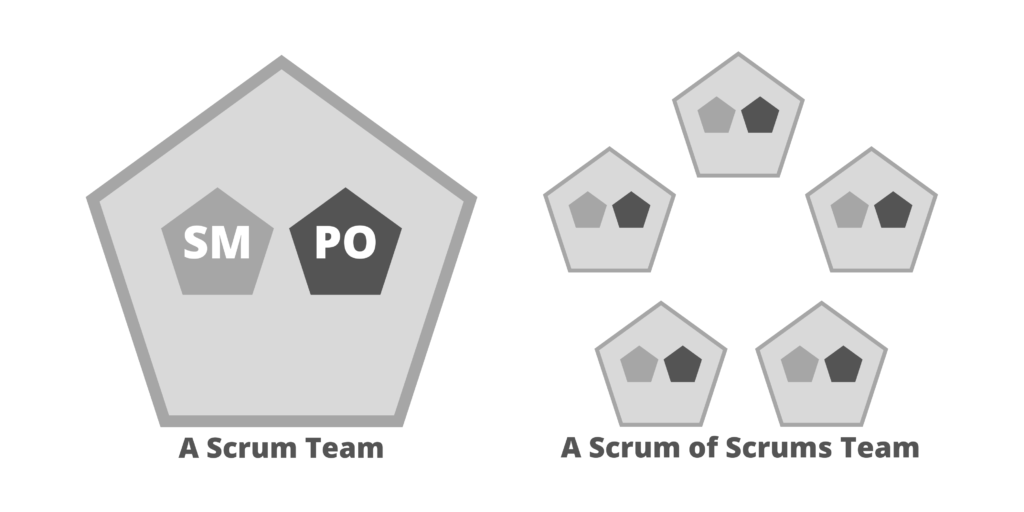
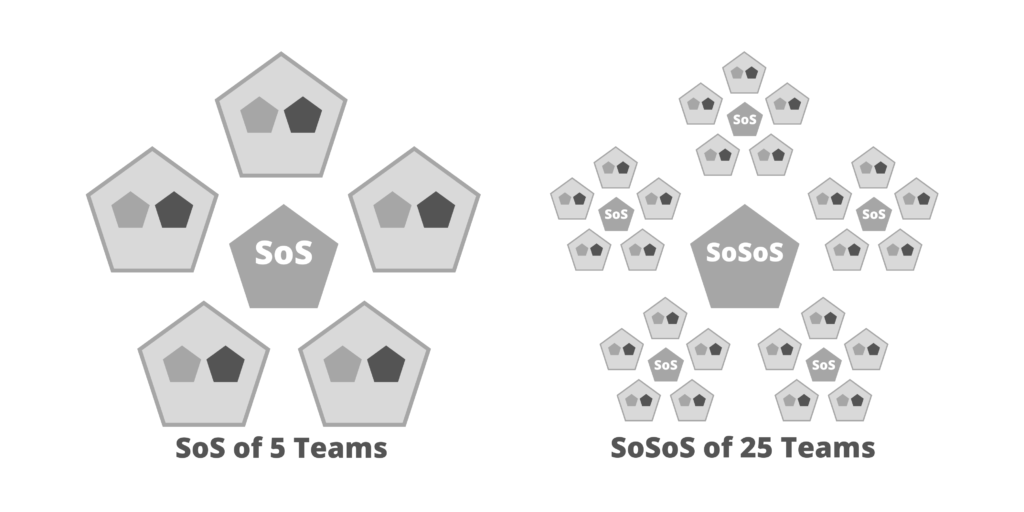
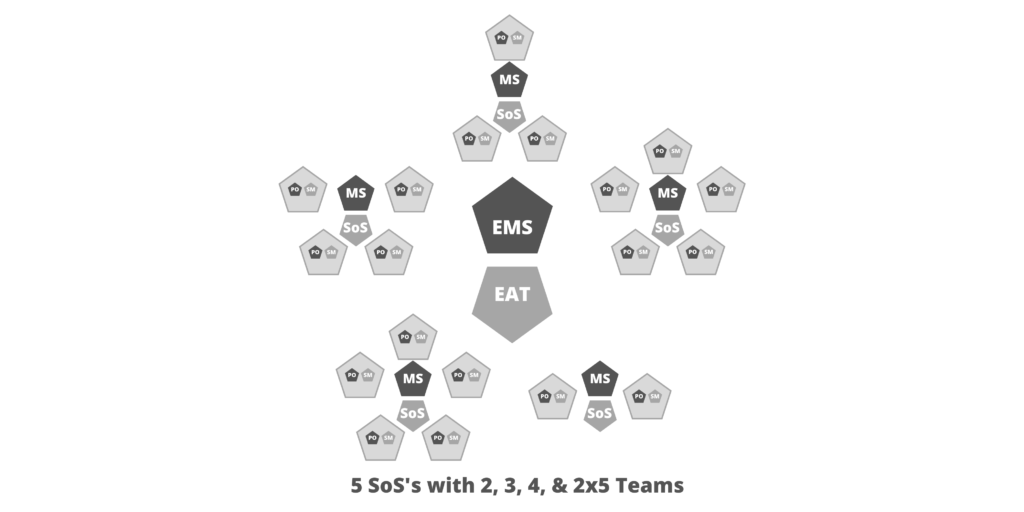
A Scrum of Scrums operates as if it were a Scrum Team, satisfying the Team Process component with scaled versions of the Scrum accountabilities, events, and artifacts. While the Scrum Guide defines the optimal team size as being fewer than 10 people, Harvard research has determined that the optimal team size is 4.6 people (on average). Therefore, the optimal number of teams in a Scrum of Scrums is 4 or 5.
As a dynamic group, the teams composing the Scrum of Scrums are responsible for a fully integrated set of potentially shippable increments of product at the end of every Sprint. Optimally, they carry out all of the functions required to release value directly to customers.
Scrum of Scrums of Scrums (SoSoS)
Depending upon the size of the implementation, more than one Scrum of Scrums may be needed to deliver a complex product. In such cases, a Scrum of Scrum of Scrums (SoSoS) can be created out of multiple Scrums of Scrums. Each of these will have scaled versions of each Scrum of Scrums’ roles, artifacts, and events.
Scaled Events
- Scaled Daily Scrum (SDS).
- The main talking points of a Daily Scrum are the progress towards the Sprint Goal and impediments to meeting that commitment.
- In a scaled setting, the Scrum of Scrums needs to understand collective progress and be responsive to impediments raised by participating teams; therefore, at least one representative from each team attends a Scaled Daily Scrum (SDS).
- Any person or number of people from participating teams may attend as needed.
- To optimize collaboration and performance, the Scaled Daily Scrum event mirrors the Daily Scrum, in that it:
- Is time-boxed to 15 minutes or less.
- Must be attended by a representative of each team.
- Is a forum to discuss how teams can work together more effectively, what has been done, what will be done, what is going wrong & why, and what the group is going to do about it
- Some examples of questions to be answered:
- What impediments does a team have that will prevent them from accomplishing their Sprint Goal or that will impact the delivery plan?
- Is a team doing anything that will prevent another team from accomplishing their Sprint Goal or that will impact their delivery plan?
- Have any new dependencies between the teams or a way to resolve an existing dependency been discovered?
- Scaled Retrospective.
- Every Sprint, the Scrum of Scrums holds a scaled version of the Sprint Retrospective where the Scrum Masters of each team get together and discuss what experiments have been done to drive continuous improvement and their results.
- Additionally, they should discuss the next round of experiments and how successful improvements can be leveraged across the group of teams or beyond.
Scaled Accountabilities
- Scrum of Scrums Master (SoSM).
- The Scrum of Scrums Master is accountable for ensuring the Scaled events take place, are productive, positive, and kept within the time box.
- The Scrum of Scrums Master may be one of the team's Scrum Masters or a person specifically dedicated to this role.
- They are accountable for the release of the joint teams' efforts and continuously improving the effectiveness of the Scrum of Scrums. This includes greater team throughput, lower cost, and higher quality. In order to achieve these goals, they must:
- Work closely with the Chief Product Owner to deliver a potentially releasable product increment at least every Sprint.
- Coordinate the teams’ delivery with the Product Owners' Team's release plans
- Make impediments, process improvements, and progress visible to the organization
- Facilitate the prioritization and removal of impediments, paying particular attention to cross-team dependencies
- Executive Action Team (EAT).
- It fulfills the Scrum Master accountabilities for an entire agile organization. This leadership team creates an agile ecosystem that allows the Reference Model to function optimally, by:
- Implementing the Scrum values
- Assuring that Scrum roles are created and supported
- Scrum events are held and attended
- Scrum Artifacts and their associated commitments are generated, made transparent, and updated throughout each Sprint.
- Formulating guidelines and procedures that act as a translation layer between the Reference model and any part of the organization that is not agile.
- The Executive Action Team is accountable for removing impediments that cannot be removed by members of the Scrum of Scrums (or wider network).

Notes
- Scrum@Scale is also known as Scrum of Scrums.
References