Showing posts with label Decision-Making. Show all posts

Governance Meetings in Holacracy

The focus of this meeting is to modify the structure of the circle. In a Governance meeting, you can:

  • Create, remove, or modify the roles of the circle.
  • Create, remove, or modify the policies of the circle.
  • Elect people to the elected core roles of the circle (Facilitator, Secretary, and Circle Rep).

1. Check-In Round

The Facilitator invites participants, one at a time, to share a check-in to call out distractions and get present. No discussion.

2. Build Agenda

Participants build the agenda of tensions to process, using one or two words per item as a reminder for the agenda item owner.

3. Process Agenda Items

Use the Integrative Decision-Making (IDM) process for each agenda item.

  • Presents the proposal.
    • The proposer states their proposal, optionally sharing their tension.
    • Others can help if the proposer asks, but only to craft an initial proposal, not improve it or reach a consensus.
  • Clarifying Questions.
    • Anyone may ask the proposer questions to better understand the proposal, but not to try to influence it. 
      • No discussion. No reactions. 
    • The proposer can respond “Not specified” to any question.
  • Reaction Round.
    • The Facilitator asks each participant (except for the proposer) for a reaction, one at a time. 
      • No discussion. Reactions are directed to the space, not to individuals.
  • Option to Clarify.
    • The proposer may clarify the intent or amend the proposal, but they have no obligation to do so. 
      • No one else may speak, not even to help.
  • Objection Round.
    • The Facilitator asks each participant (including the proposer):
      • "Do you see any reason why adopting this proposal causes harm, objection, or no objection?
    • Each objection is stated without discussion. 
      • The Facilitator may test objections.
  • Integration
    • Integrate one objection at a time. 
    • The goal is an amended proposal that removes the objection and addresses the proposer’s tension. 
    • Anyone can participate, but the focus should be on the proposer and the objector.
      • Start with the objector, but allow contributions from anyone. 
        • Ask the objector: "What can be added or changed to remove that issue?"
      • Don’t wait for consensus. With each idea:
        • Ask the objector, "Would this resolve your objection?" If the answer is "Yes," then ask the proposer, "Would this still address your tension?"
      • After all the objections are integrated, repeat the Objection Round.

    4. Closing Round

    The Facilitator invites each participant, one at a time, to share a closing reflection. No discussion.
    Share:

    Generative Decision Making Process

    A consent-based decision-making process built on the integrated decision-making method of Holocracy.

    1. Ripeness

    Is the time ripe for the decision? Is the context clear? Is there information needed to be gathered?

    • "I am going to put the timer on for 10 minutes while you explore the topic in question"
    • Listen deeply and when you sense that there is a possible proposal the time is ripe.

    2. Proposal Version 1

    Invite the group to volunteer to create a proposal.

    • "Would someone like to make an initial proposal?"
      • Help the proposer name the proposal.
      • The proposal is written for all to see not just the proposer.
    • Avoid letting the proposal spread into multiple proposals.

    3. Clarifications

    Opportunity to ask the proposer questions. 

    • The proposer has two options:
      • They provide the answer or
      • They say "Not specified" if the answer is unknown.
    • If someone is speaking without having a question:
      • Remind them it is a question period.
    • Avoid letting the proposer speak about anything other than giving a direct answer (keep it right).

    4. Reactions

    Give each person (except the proposer) the opportunity to express to the group their reaction to the proposal.

    • Everyone's voice and perspective need to be heard.
    • The proposer listens deeply and makes notes.
    • Afterward, the proposer will craft a new version of the proposal.
    • Make sure that the reaction is not about the proposer but about the proposal itself - step in if necessary.

    5. Proposal Version 2

    The proposer formulates a new version of the proposal in light of all that has been said.

    • Have the proposer write the new version and make sure it is visible to all:
      • Read it out loud.
    • If the proposer wants to stay with the original proposal:
      • Remind them they can.
    • If you sense the proposer needs support in formulating the second version: 
      • Remind them they can ask for help.

    6. Objections

    Ask for objections. An objection needs to express a risk or a backward movement for the organization or initiative.

    • Listen to the objection and decide if it is valid or not.
      • Sometimes people might express personal concerns that are not in fact organizational risks. You need to differentiate between the two.
      • If you are not sure, you may ask the group to help.
    • If it is valid:
      • Ask the proposer to integrate it into a new version of the proposal. 
      • Repeat the objection round.

    7. Visual Confirmations

    Have everyone visually confirm that they can live with this decision by raising their thumbs. This is a way of allowing all to see that everyone is fully on board with the decision.

    • If there is a concern that has not been raised, it will show up because a person will be unable to raise their thumb. This can happen when:
      • The person is struggling to find the words to express an idea that is important to them or
      • The person is disengaging from the process.
    • The concern needs to be addressed.
      • The group needs to return to the part of the process that was not fully addressed.

    Fast-tracking

    It is good to have a cultural cue as visual confirmation that a proposal may be fast-tracked.
    • Someone makes a proposal, and you can just do a quick check-in right away to see if everyone can live with it.

    References

    Share:

    The Evidence Based Management

    What is Evidence Base Management?

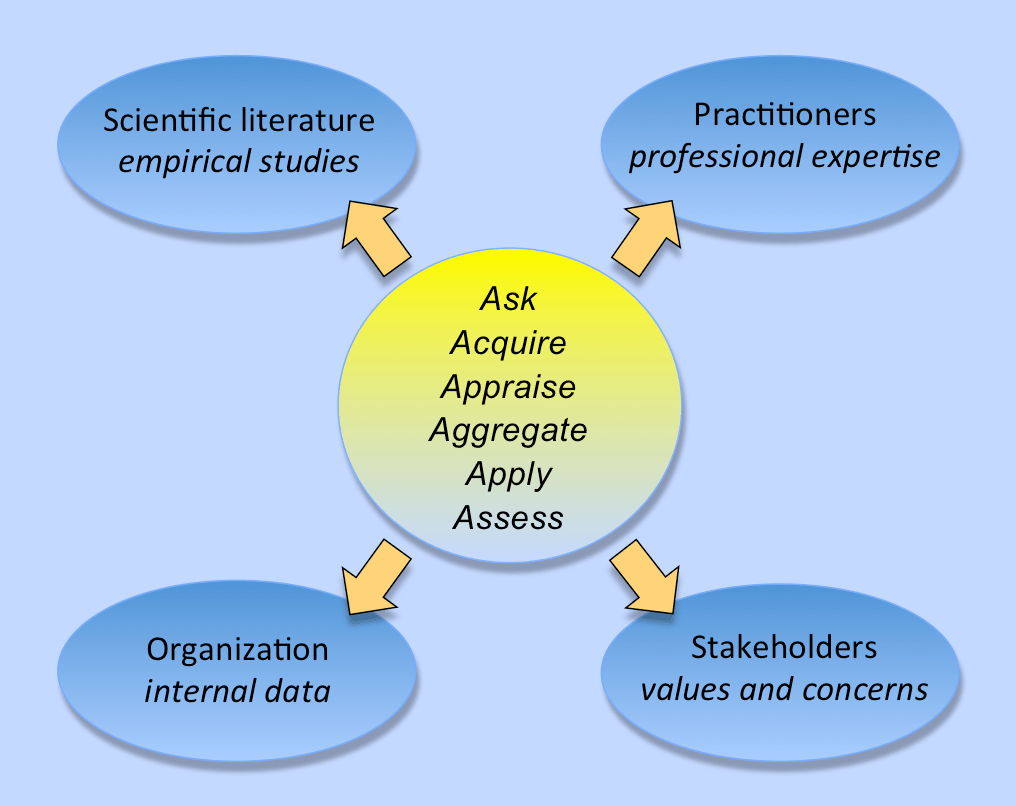
    Evidence-based management is about making decisions through the conscientious, explicit, and judicious use of the best available evidence from multiple sources:

    • Asking: Translating a practical issue or problem into an answerable question.
    • Acquiring: Systematically searching and retrieving the evidence.
    • Appraising: Critically judging the trustworthiness and relevance of the evidence.
    • Aggregating: Weighing and pulling together the evidence.
    • Applying: Incorporating the evidence in the decision-making process.
    • Assessing: Evaluating the outcome of the decision taken.

    ... to increase the likelihood of a favorable outcome.


    TBD

    References

    Share: