
Coaching with FOTO

What is FOTO?
FOTO stands for "From Obstacles to Outcomes", and the game's objective is to generate as many outcomes as you can in the allotted time – 15 minutes for a table group working together in the Lite edition, or 3-4 minutes per rotation (plus some changeover time) through the Classic edition’s roles of client, coach, and host.
As well as an objective, 15-minute FOTO has rules, two of them – it is a game after all! They make it a generative process:
- You can only ask questions from the card
- For the X's in many of the questions, you must use previous answers or fragments thereof, verbatim
There are no wrong answers, but the intent of the questioning should be to elicit outcomes in a spirit of curiosity, not to fish for solutions (suggesting solutions isn’t possible within the rules). In view of the game’s objective, questioners – 'coaches' – are advised not to waste time digging into obstacles; however, some quick clarification may be helpful.
References
Introduction to Clean Language Questions
The Clean Language questions were developed by counseling psychologist David Grove, who instead of giving advice, went by his client’s choice of words rather than paraphrasing and devised questions that contained as few assumptions and metaphors as possible.
Clean Language is a new way of thinking about the way people think, with profound implications and powerful effects. As a general principle, Clean Language questions are about the positive stuff in the speaker’s landscape – the resources they have, and the outcomes they desire.
Developing Questions
- Elaborate. These are the two most common Clean Language questions. Invite the person to elaborate on their experience, to find out more about it. It is recommended to ask these questions predominantly on the positive aspects of the person's experience.
- "(And) what kind of X is that X?"
- "(And) is there anything else about X ?"
- Name and address. Encourage a person to elaborate on the thing they have mentioned to give more details. Clarify what the person is thinking about and where it is. Useful to explore emotions.
- "(And) where is X?"
- "(And) whereabouts it X?"
- Asking for a metaphor. Once you have identified some symbols and locations, ask:
- "(And) that X is like what?"
- Relationship questions. Once you have two symbols, you can find out if, and how, they relate to each other.
- "(And) is there a relationship between X and Y?"
- "(And) when X, what happens to Y?"
Sequence Questions
- "(And) then what happens?"
- "(And) what happens next?"
- "(And) what happens just before X?"
Source Questions
- "(And) where could X come from?"
Intention Questions
- "(And) what would you like to have [to] happen?"
Necessary Condition Questions
- "(And) what needs to happen for X?"
- "(And) can X happen?"
Questions that utilize other verbs
- "How do you know X?"
- "Does … have a size or a shape?"
- "What determines … ?"
- "Where does / could … come from?"
- "Can … ?"
The Syntax
You may be wondering what has happened to the ‘and’ I mentioned before. That comes in when you combine one of these questions with the client’s words.
A clean question has three functions:
- To acknowledge what the client has said.
- To direct their attention to one aspect of their experience.
- To send them on a quest for self-knowledge.
- "And you would like to be more healthy" (acknowledge)
- "And when more healthy," (direct attention)
- "Is there anything else about that?" (quest for self-knowledge)
References
The Failure Mode and Effects Analysis (FMEA)

What is an FMEA?
Also called: potential failure modes and effects analysis; failure modes, effects, and criticality analysis (FMECA)
- "Failure modes" means the ways, or modes, in which something might fail. Failures are any errors or defects, especially ones that affect the customer and can be potential or actual.
- "Effects analysis" refers to studying the consequences of those failures.
When to Use FMEA?
- When a process, product, or service is being designed or redesigned, after deployment.
- When an existing process, product, or service is being applied in a new way.
- Before developing control plans for a new or modified process.
- When improvement goals are planned for an existing process, product, or service.
- When analyzing failures of an existing process, product, or service.
- Periodically throughout the life of the process, product, or service.
Process
- Assemble a cross-functional team of people with diverse knowledge about the process, product or service, and customer needs.
- Identify the scope of the FMEA.
- "Is it for the concept, system, design, process, or service?"
- "What are the boundaries?"
- "How detailed should we be?"
- Use flowcharts to identify the scope and to make sure everybody understands it in detail.
- Fill in the identifying information at the top of your FMEA form.
- The remaining steps ask for information that will go into the columns of the form.
- Identify the functions of your scope. Ask:
- "What is the purpose of this system, design, process, or service?"
- "What do our customers expect it to do?"
- Name it with a verb followed by a noun. Usually, one will break the scope into separate subsystems, items, parts, assemblies, or process steps and identify the function of each.
- For each function, identify all the ways failure could happen.
- These are potential failure modes. If necessary, go back and rewrite the function with more detail to be sure the failure modes show a loss of that function.
- For each failure mode, identify all the consequences on the system, related systems, process, related processes, product, service, customer, or regulations.
- These are potential effects of failure. Ask,
- "What does the customer experience because of this failure?"
- "What happens when this failure occurs?"
- Determine how serious each effect is.
- This is the severity rating or S. Severity is usually rated on a scale from 1 to 10, where 1 is insignificant and 10 is catastrophic.
- If a failure mode has more than one effect, write on the FMEA table only the highest severity rating for that failure mode.
- For each failure mode, determine all the potential root causes.
- Use tools classified as cause analysis tools, as well as the best knowledge and experience of the team.
- List all possible causes for each failure mode on the FMEA form.
- For each cause, determine the occurrence rating, or O.
- This rating estimates the probability of failure occurring for that reason during the lifetime of your scope.
- Occurrence is usually rated on a scale from 1 to 10, where 1 is extremely unlikely and 10 is inevitable.
- On the FMEA table, list the occurrence rating for each cause.
- For each cause, identify current process controls.
- These are tests, procedures, or mechanisms that you now have in place to keep failures from reaching the customer.
- These controls might prevent the cause from happening, reduce the likelihood that it will happen, or detect failure after the cause has already happened but before the customer is affected.
- For each control, determine the detection rating, or D.
- This rating estimates how well the controls can detect either the cause or its failure mode after they have happened but before the customer is affected.
- Detection is usually rated on a scale from 1 to 10, where 1 means the control is absolutely certain to detect the problem and 10 means the control is certain not to detect the problem (or no control exists).
- On the FMEA table, list the detection rating for each cause.
- Optional for most industries: Ask
- "Is this failure mode associated with a critical characteristic?" (Critical characteristics are measurements or indicators that reflect safety or compliance with government regulations and need special controls.)
- If so, a column labeled "Classification" receives a Y or N to show whether special controls are needed. Usually, critical characteristics have a severity of 9 or 10 and occurrence and detection ratings above 3.
- Calculate the risk priority number, or RPN, which equals S × O × D.
- Also calculate Criticality by multiplying severity by occurrence, S × O.
- These numbers provide guidance for ranking potential failures in the order they should be addressed.
- Identify recommended actions.
- These actions may be design or process changes to lower severity or occurrence.
- They may be additional controls to improve detection.
- Note who is responsible for the actions and target completion dates.
- As actions are completed, note the results and the date on the FMEA form.
- Note new S, O, or D ratings and new RPNs.
Notes
- This is a general procedure.
- Specific details may vary with the standards of your organization or industry.
- Before undertaking an FMEA process, learn more about standards and specific methods in your organization and industry through other references and training.
References
The 5 Whys Method
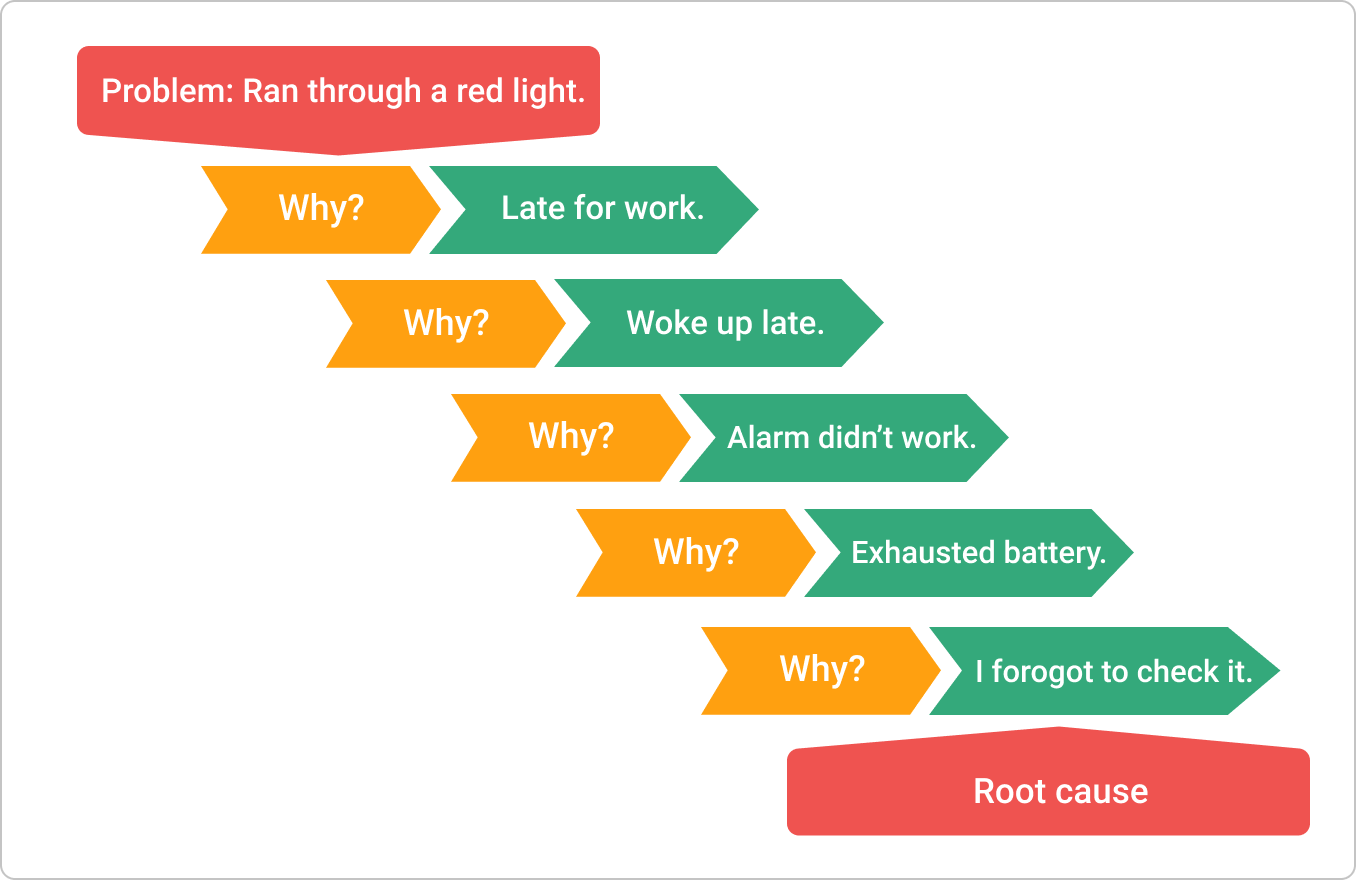
The 5 Whys technique is a simple and effective tool for solving problems. Its primary goal is to find the exact reason that causes a given problem by asking a sequence of "Why" questions.
Step by Step
- Form a team.
- Try to assemble a team of people from different departments. Each representative has to be familiar with the process that is going to be investigated.
- Be aware that this is not an individual task, and it needs to be executed by the team.
- Define the problem.
- Discuss the problem with the team and make a clear problem statement.
- It will help you define the scope of the issue you are going to investigate.
- Ask Why.
- Empower one person to facilitate the whole process. This team leader will ask questions and try to keep the team focused.
- The answers should be based on facts and real data, rather than on emotional opinions.
- The facilitator should ask "Why" as many times as needed until the team can identify the root cause of the initial problem.
- Take Action.
- After the team detects the root cause(s), it is time to take corrective actions. All members should be involved in a discussion to find and apply the best solution that will protect your process from recurring problems.
- When the decision is made, one of the team members should be responsible for applying the right actions and observing the whole process.
- After a certain period of time, the team needs to meet again and check if their actions actually had a positive impact. If not, the process should be repeated.
- In the end, the case should be documented and sent across the organization.
Hints
- Don’t ask too many Whys. If you keep going, you may end up receiving tons of unreasonable suggestions and complaints, which is not the purpose. Focus on finding the root cause.
- Sometimes there could be more than one root cause.
- In these cases, the 5 Whys analysis will look more like a matrix with different branches.
- This may even help you detect and eliminate organizational issues that have permanent negative effects on overall performance.
Covered Scenarios
- Root cause analysis.
References
The Problem-Reframing Method
"As Peter Drucker pointed out, there’s nothing more dangerous than the right answer to the wrong question. There is a way to do better. The key is reframing, a crucial, underutilized skill that you can master with the help of the book "What's Your Problem?..." - Amazon.com
.png)
Frame the Problem
- What is the problem we are trying to solve?
- Don’t accept the problem statement at face value. Ask:
- Is the statement true?
- Are there self-imposed limitations?
- Is a solution "baked into" the problem framing?
- Is the problem clear?
- With whom is the problem located?
- Are there strong emotions?
- Are there false trade-offs?
Look Outside the Frame
- What are we missing?
- Avoid delving into the details of the issue you face. Zoom out. Ask:
- What's missing from the current problem statement?
- Are there elements we're not considering?
- Is there anything outside the frame that we're not currently paying attention to?
- Look beyond your own expertise, and hidden influences, and consider causal events prior to the situation.
Rethink the Goal
- Is there a better objective to pursue?
- As we focus on the problem and how to solve it, it “prevents us from questioning a more important thing: the goal we’re trying to reach.”
Examine Bright Spots
- Where is the problem not?
- "Look for situations or places where the problem is not as bad, or where it may even be entirely absent. Paying attention to such positive exceptions can give you a new perspective on the problem, and may even point you directly to a viable solution."
Look in the Mirror
- What is my/our role in creating this problem?
- "Even if you don’t contribute to the problem, ask whether you can react differently to it.”
Take Their Perspective
- What is their problem?
- "Discovering how others see the world—and in particular, how they see it differently from you—is perhaps the most fundamental form of reframing there is."
- Try to disregard your own preferences. Focus only on how they might feel and think.
Move Forward
- How can I validate my/our framing of the problem through real-world testing?
- After you have reframed the problem, test it out to see if you are, in fact, targeting the right problem. You may have a number of reframed problems at the end of this process. In that case, narrow them down by looking for surprising, simple, r significant-if-true framings.
The Seven Practices for Effective Reframing
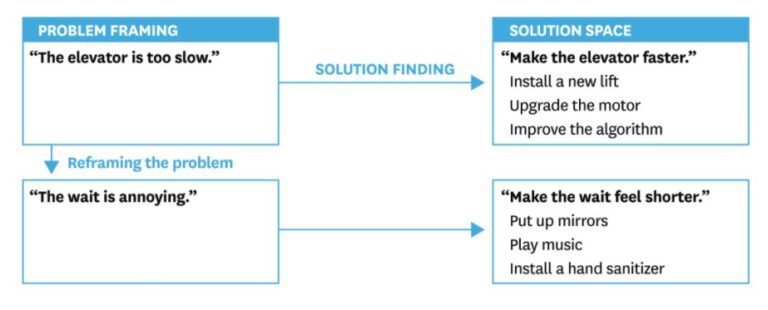
- Establish legitimacy – It is difficult to use reframing if you are the only person in the room who understands the method. Show them this article, or relate the slow elevator problem and solution.
- Bring outsiders into the discussion – This is the single most helpful reframe practice. Search for people who understand but are not entirely in your world, and who can speak freely. Don’t expect solutions, but instead, input.
- Get people’s definitions in writing – People commonly leave a meeting believing they all agree with something just to find out months later that they actually had different views. Writing it down can help define differences and look contrarily at the problem
- Ask what’s missing – When facing a problem description, we tend to go deep into the details of what has been stated, perhaps overlooking what has been missed.
- Consider multiple categories – Transforming people’s perception of the problem can bring powerful changes. One method is inviting people to specify which category of the problem they are facing. Is it a motivation problem? A quality problem? An attitude problem? Then try to suggest more categories.
- Analyze positive exceptions – You can look for new insights and try to find instances when the problem did not occur: “What was different about that situation?“
- Question the objective – You can reframe a problem by clarifying and challenging the objectives of all involved parties. The slow elevator problem shows us an objective change from making the elevator faster to improving the waiting time experience.
References
How to Solve Difficult Problems (25 Lenses)
"To find better solutions, you need to first ask better questions. The questions you ask determine which solutions you'll see and which will remain hidden. The Invisible Solutions book by Stephen M. Shapiro contains the formulas to reframe any problem in multiple ways, using 25 lenses to help you gain different perspectives." - Amazon.com
.png)
Reduce Abstraction
- 1 - Leverage:
- What is the one factor that will have the greatest impact?
- What gives us the greatest leverage in solving this challenge?
- 2 - Deconstruct:
- What are the parts or components of this?
- What are the steps of the process?
- What are the different segments?
- 3. Reduce:
- How might lowering our goals and expectations give us a better result or create new opportunities for growth?
- How can simplification increase usability and accessibility?
- 4. Eliminate:
- How can this be eliminated?
- Instead of adding features, what features can you remove?
- 5. Hyponym:
- Is there a more specific instance of a word that can replace the one originally chosen?
Increase Abstraction
- 6. Analogy:
- What is this like?
- Who else has solved a problem like this?
- 7. Result:
- What does this make possible?
- What is the desired outcome?
- 8. Concern Reframe:
- How can we take a progress-blocking statement and convert it into a question that starts with "How can we...?"
- 9. Stretch:
- Are our challenge criteria stretched enough?
- Are we shooting for a high enough goal?
- 10. Hypernym:
- How can we replace a word in the challenge statement with a less specific instance of the one originally chosen?
Change Perspective
Zero-In and the Change Perspective lenses should always be considered.
- 11. Resequence:
- How can we delay a decision until later in the process when we have more or better information?
- How can we make a decision earlier in the process, before we have all the necessary information?
- How can we perform multiple tasks in parallel?
- 12. Reassign:
- Who else could perform this task?
- How can we generalize the question so that it does not imply anyone in particular?
- How else might this task be accomplished (e.g. via automation)?
- 13. Access:
- How can we change ownership words to "access" words, such as rent, subscribe, lease, or use?
- 14. Emotion:
- How can we shift from corrective words such as "improve," "fix," or "reduce," to a more aspirational goal?
- How can we reframe the challenge in a way that stimulates solvers from an emotional perspective?
- 15. Substitute:
- How can we swap out one or more words in the problem statement for different terms?
Switch Elements
- 16. Flip:
- How can we turn the problem upside down by improving a different factor?
- 17. Conflicts:
- How can we design the challenge to allow for and embrace conflicting attributes?
- 18. Performance Paradox:
- What can we focus on other than the outcome?
- 19. Pain vs Gain:
- What is the pain we need to solve?
- What might be lost if we don’t solve this problem?
- 20. Bad Idea:
- How can we turn a bad idea into a good one?
- What will give you what you don’t want—and then do the opposite?
Zero-In
- 21. Real Problem:
- Do we really know the underlying problem we want to solve?
- Are we solving the root cause of the problem?
- 22. Real Business:
- What business are we really in?
- Who are our real competitors?
- What new technology can make us irrelevant?
- 23. Insights:
- What data would help reframe the question or provide insights into better solutions?
- 24. Variations:
- If your question implies that all customers/situations are treated the same, ask, "How can we address exceptions or rare cases in different ways?"
- 25. Observation:
- Instead of asking our customers what they want, how can we observe them?
References
The Five Types of Presentations
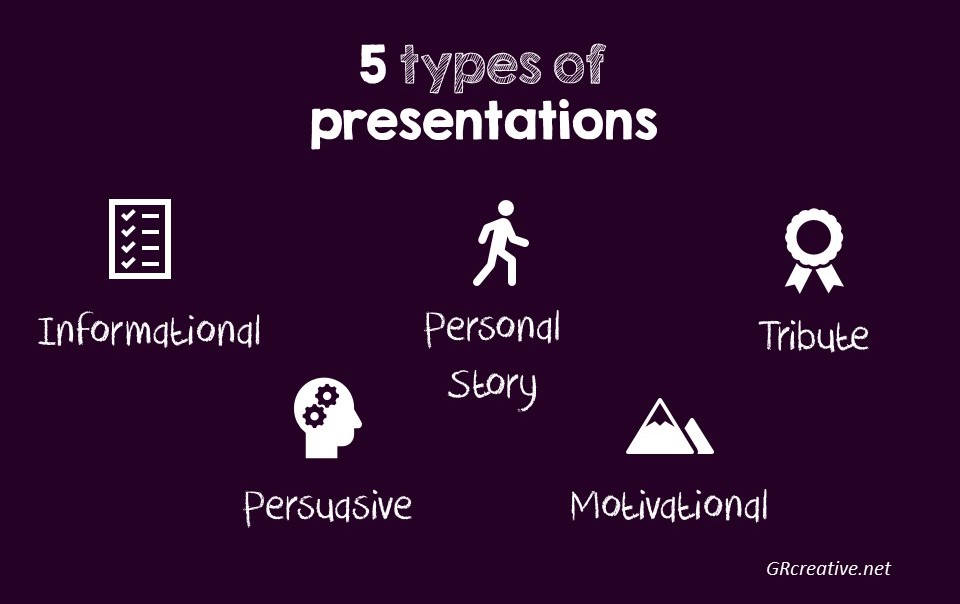
Informational ("What I know…")
Status reports, conference research presentations, issue overviews…this is the most common presentation and inherently the most boring. The presenter is focusing on a simple transaction, transferring information to their audience.
- Follow the What->So What->Now What test to make sure you select only the most essential information and keep it relevant to your audience’s needs.
Personal Story ("What I learned…")
Stories help illustrate greater truths, they also humanize concepts in a way that facts and data simply can’t. The best stories provide entertainment on the way to a lesson.
- Adhere to the drama triangle, that all stories have tension and there is usually a hero, a victim, and a villain.
- The hero needs to be fighting against something in order to ideally benefit the greater good. But, before you go and constantly make yourself the hero of every story, remember humility helps sell lessons learned.
Tribute ("What I admire…")
This approach is inherently emotional since it usually commemorates one of life's big moments: awards, weddings, retirement, and even eulogies. Your job is to make the case for the actions and impact of another, by illustrating how they’ve been special and made a difference.
- By and large, be careful not to insert too much of yourself into a tribute.
- You are a witness to someone or something's greatness, not the focus.
- In fact, one of the nicest and most compelling things you can say about another person is that you could never or could only ever hope to accomplish what they have.
Persuasive ("What I believe...")
In any pitch, you are diagnosing a problem, proposing a solution, and selling the benefits of that solution. There is still a very personal element to that line of thinking, which you can use to your advantage.
- Develop your persuasive argument by incorporating the three pillars of persuasion: ethos (personal values), pathos (emotion), and logos (logic).
- By mixing each, you can build the strongest act of persuasion possible.
Motivational ("What world I want to live in…")
They are about making people "see the stars" and are built on aspirations. Often, the motivational approach is the opposite of persuasion, because you ask the audience to dream and have faith, not consider numbers, data, or even precedent. Because you have a lot less concrete information to speak from, this approach is the most likely to make use of famous quotations, historical achievements, and "what if" thinking.
- A good place to start when planning a motivational talk is by recognizing prevailing thinking and looking for ways to challenge validity.
References
The 3-Minute Rule
Learning how to structure your presentation effectively so that it concludes all the important and relevant information inside the three minutes, evolution allotted minutes.
The objective is to feed your information and easily comprehensible statements and naturally graspable stages that would allow your audience to format a core understanding of the value of your proposition effectively.
If you want them to see your proposal the way you see your proposal, your audience must conceptualize your idea. Contextualize how it would benefit them, and then actualize it with potential engagement or further interest.
The essence of a successful presentation is to WHACK your story.
WHACK
- What is it? (50% or 1 min 30 secs)
- What is the most significant need that your product or start-up fills?
- What problem does it solve?
- What makes it unique?
- How does it work? (30% or 1 minute)
- Does your presentation explain why the elements of your offer are valuable or important?
- Does it explain how your product works or how to achieve your goal?
- How can you deliver on your promise?
- Are you sure? (15% or 20 seconds)
- Is your information backed by a fact or a figure?
- Does your presentation prove something?
- Has a third party verified your claims?
- What have you said that someone might not believe?
- These should only back up or verify your offer and should come only after.
- Can you do it? (5% or 10 seconds)
- What have you done that's similar that proves you can do it?
- How have you trained for this?
- Do you have the necessary connections?
- What are the repercussions of underperformance?
Opening
- Why? - Your reason for being.
- Tell them how you came to be involved in your idea and how you figured out it was good.
- Tell them why you are excited about your idea.
The All-Is-Lost
- Create a moment by bringing up a problem that is jeopardizing or might jeopardize the success of your project.
- Don't let your audience find a negative out by themselves.
The Hook
- It is the one thing or element about your idea that makes your audience go "oh, that's cool".
- It comes near the end.
The Edge
- It is a story that has a little oomph to it, one that you can justifiably end with.
- Find a story and at least for a second, make your audience think "oh, I didn't know that".
The Callback
- It is the moment you say "See what I'm talking about?"
- It is the moment you repeat the reason for being and verify it.
- The callback tells your audience "now you see it too, don't you?"
Example of a Slide Deck
- All-Is-Lost. One slide (optional).
- The Hook. One slide.
- The Edge - One slide (recommended to use one image).
- The Callback - No slide (it must be spontaneous for your audience).
- Can you do it? - One slide (optional, just explain it).

References
How to Give Feedback
Step by Step
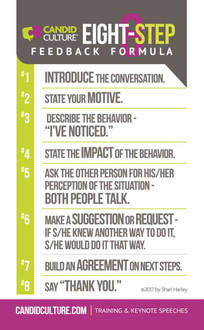
- Introduce the conversation by asking for a few minutes.
- "Is it a good time for the other person to talk?."
- "John when you have 5 minutes, I need to talk to you."
- State your motive.
- Let them know you are speaking because you have their best interests at heart.
- "This is a little awkward and may be uncomfortable. I want you to know that while I wish I didn't have to tell you this, I'm doing it because I care about you and I want you to be successful."
- Describe the observed behavior.
- Picture a specific recent example of what you're referring to.
- "John, I've noticed that you have an odor."
- Share the impact or result of the behavior.
- Explain what happened as a result of the person's action.
- "I know this is a very awkward subject (empathize). We work in a small space. I don't want others to avoid working with you or say negative things about you. And as awkward as this is, I would rather you hear this from me than someone else. Sometimes health conditions can cause certain odors, as can eating some foods."
- In dialogue, ask the recipient for their perception of the situation.
- Ask questions, and have a dialogue.
- "What are your thoughts?" or
- "What happened?"
- Make a suggestion or request for what you'd like the person to do next time.
- "I'm very sorry to tell you this. Please make sure you shower every day before coming to work and wash your clothes each time you wear them. And please tell me if there is something else you'd like me to know."
- Build an agreement about the next steps.
- You can skip it based on the awkwardness of the subject.
- Say thank you.
- "Thank you for being willing to have this conversation with me."
Preparation
- Questions for you to consider answering before a difficult feedback conversation
- What's working? What is not working?
- What's the most important for this person to know?
- What would you like this person to do differently?
- What are your requests?
- What do you want to say but probably won't?
- What would you say first?
- When delivering feedback.
- Privately (when possible).
- Within a week of the incident.
- You or the feedback recipient are not upset. If you are upset, wait 24 hours until you are calm.
- You have sufficient time for the conversation.
- The recipient is not having a day during which everything has gone wrong (personal or professional speaking)
- Neither of you goes on vacation the next day.
- More than one piece of feedback.
- Address each issue individually.
- Once you have agreed on the next steps, then repeat the formula.
- Give a small amount of feedback. No more than 3 things to work on at one time.
- Address those things that still haven't changed.
Statement Examples
- When taking responsibility.
- "I probably should have said something a long time ago. I'm sorry I didn't. The purpose of this conversation is to ensure you get what you need from me as your manager."
- When the behaviors are indirectly observed by another person:
- "Mary I appreciate you telling me this. I know you asked me not to share it, and I want to respect your confidentiality. But it's a big deal and I have to pass on the feedback. How can I share the information so that you are comfortable? Do you want to talk to X yourself, I'm sure they will be receptive or Do you want me to talk to them?"
- "I can't identify the source of this information, and I know that's frustrating. Typically, if I can't share the source, I don't give feedback. But I think it's important for you to know this. Here is my suggestion, as difficult as this will be: rather than trying to figure out who said what, just alter your behavior. You might also tell the people with whom you work most closely that you got some feedback on ___ and you are working to improve in that area. Tell your coworkers that you would appreciate any feedback they have. Then after you've made some changes, go back to them. Share what you've done differently and ask again for specific feedback."
- When asking for their perception:
- If you say the wrong thing or the message comes out stronger than you would like, apologize.
- If the person is too emotional say:
- "I can see this is very upsetting and I'm sorry about that. Why don't we finish this conversation another time?" - when the person is calm, resume the conversation.
- "I'm sorry you feel that way."
- When making the request, be direct:
- "Here is my request, when..., Does it work for you?"
- When thanking:
- "Thanks for being willing to have this conversation with me. It was hard for me to talk to you about this... But our working relationship matters to me, and I want to feel ..."
Quick Feedback
- "(Describe what you observed for feedback). I came across an article the other day that had some good ideas on how to..., Would you like me to make you a copy? or Would you like to hear a few ideas?"
- "I'm realizing that when we started working together we never talked about our working-style preferences - our preferred method of communication, desired response time, how we handle questions, and so forth. I think it would be useful to have this conversation. What do you think? Would you like to do that now or schedule another time?"
Requesting Feedback Model
- Ask for feedback.
- Promise you will say "Thank You" regardless of what the person says.
- Don't get defensive even if you think the other person is wrong.
- The feedback is true for them
- Deal with the other person's experience.
- Your opinion of what happened makes no difference.
- Tell them
- "I've been working on ___"
- "I'd really like your feedback"
- "I'd specifically like feedback on ___ and ___""
- "Here are the opportunities in the next 2 weeks to see me do this (or review this piece of work)"
- "Can we schedule a meeting to discuss this?"
Examples
- Asking 6 people for feedback:
- "What is the first impression I create?."
- "What was I like to work with, or what do you think I would be like to work with?."
- "If my coworkers were asked to talk about me when I wasn't there, what would they say?."
- "How have I exceeded your expectations."
- "How have I disappointed you?."
- Asking for general feedback.
- "We have been working together for a really long time. We see a lot of each other work and I realized that we never talk about it. I think it would be really helpful if we give each other feedback about what's working, and what we might do differently. What do you think? Is it something you'd like to do?"
- Ask for specific feedback.
- "I have been working very hard to strengthen my skills on X subject. Would you be willing to watch me in X's situation and give me some feedback? I'd really appreciate your insights. In fact, I'd really like more feedback in general. If you be willing to bring things to my attention that get in the way of my success, I'd really appreciate it. I promise to be receptive and say thank you. Would you be comfortable doing that?"
- Asking for feedback from the direct supervisor.
- "I got some feedback on ___. I respect your judgment and I would like to hear your impressions. Would you be willing to watch for this behavior over the next two weeks? Then perhaps we can set a time to discuss your observations. Would that be okay?"
Asking others to pass the Feedback
- Ask the other to talk.
- State why you want the other person to pass the feedback.
- Describe the behavior.
- Make a suggestion or request
- Volunteer to help (optionally)
Examples
- "Steve, I need to talk to you offline. I know you have a good relationship with X, and I'm wondering if you run little interference. I've noticed that ___, Would be willing to talk to him and how to improve on ___."