How to Manage to Unsolicited Feedback

1. Receiving Unsolicited Feedback

Unsolicited feedback at best feels like someone is trying to help, at worst it feels like criticism. If you find yourself receiving unsolicited advice, you don’t have to smile politely and take it. It’s ok to put an end to feedback and advice.

How to Respond

  • Simply smile, and tell the person:
    • "I appreciate you caring enough to give me that advice, and I'm not looking for advice on that topic at this time"
  • And then smile again. 
    • Smiling softens most messages. Say nothing more. Most people will stop talking.
  • If the person continues giving you advice, simply say the same thing again.
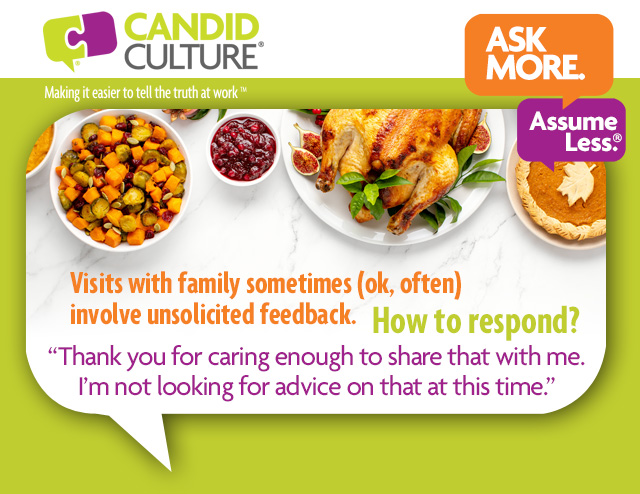
    • "Thank you for caring enough about me to share that with me. I really appreciate your concern. And I'm not looking for advice on that at this time"
  •  If the person keeps talking, just say:
    • "I'm going to get a drink", Then get up and go get a drink.

    How to Prevent It

    Most difficult conversations are preventable. And preventing a difficult conversation is always easier than having one. If stopping unsolicited feedback feels uncomfortable, prevent it. 

    • Tell people before you see them, "I don't want to talk about _____________ (fill in the blank) Please don't bring it up over Thanksgiving"
    • You can soften that request any way you like.

    2. Giving Unsolicited Feedback

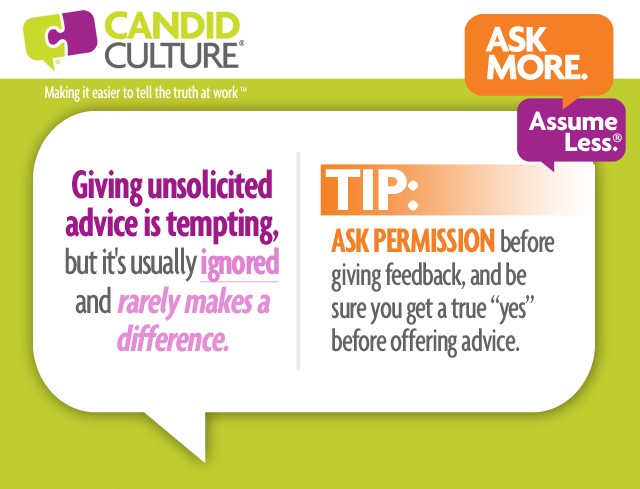
    If you really want to give unsolicited advice, ask for permission and make sure you get a true "yes" before speaking up. If you extend the invitation to talk, the other person has to be able to say no. An invitation is only an invitation if "no" is an acceptable answer. You can't ask if the person wants your input and then keep talking if he verbally or physically said no.

    How to Give Advice

    • Here are some ideas on how to introduce the advice and ask for permission before giving it:
      • "I noticed we're getting behind on the XYZ project. I have a couple of ideas about what we can do. Would you be interested in talking about them?
      • "That Monday meeting is rough. I feel for you. I used to run meetings like that. Would you be interested in talking about some meeting management strategies? I’d be happy to share what I’ve learned"
    • After you offer to talk (aka, give your opinion), listen and watch the response you get. 
      • Do the person's words and body language portray a true "yes, I’d like your opinion" or what seems like an "I know I'm supposed to say yes, but I’m really not interested" reply?
      • If you’re likely just giving unwanted advice that won't be heard. Then let it go.
    • If the person appears generally interested and open, proceed.

    Covered Scenarios

    • How to receive feedback.
    • How to receive unsolicited feedback.
    • How to respond to criticism.
    • How to give proactively feedback. 

    References

    Share:

    The Gamestorming Toolbox

    What is Gamestorming?

    Gamestorming is a set of co-creation tools used by innovators around the world. This book includes more than 80 games to help you break down barriers, communicate better, and generate new ideas, insights, and strategies. 

    • Overcome conflict and increase engagement with team-oriented games
    • Improve collaboration and communication in cross-disciplinary teams with visual-thinking techniques
    • Improve understanding by the role-playing customer and user experiences
    • Generate better ideas and more of them, faster than ever before
    • Shorten meetings and make them more productive
    • Simulate and explore complex systems, interactions, and dynamics
    • Identify a problem's root cause, and find the paths that point toward a solution

    General

    Opening

    Share:

    The Liberating Structures

    Here is a summary of the 33 Liberating Structures, you are encouraged to open the link to fully understand how to set it up right and get the real benefit. 

    List of Structures

      1. 1-2-4-All. Engage Everyone Simultaneously in Generating Questions, Ideas, and Suggestions (12 min.)
        • What is made possible?
          • Generate better ideas and more of them faster than ever before. 
          • Tap the know-how and imagination that is distributed widely in places not known in advance. Open, the generative conversation unfolds. Ideas and solutions are sifted in a rapid fashion. 
        • Structuring Invitation
          • Ask a question in response to the presentation of an issue, or about a problem to resolve or a proposal put forward (e.g., What opportunities do YOU see for making progress on this challenge? How would you handle this situation? What ideas or actions do you recommend?)
      2. Impromptu Networking. Rapidly Share Challenges and Expectations, Build New Connections (20 min.)
        • What is made possible?
          • Tap a deep well of curiosity and talent by helping a group focus attention on problems they want to solve. 
          • A productive pattern of engagement is established if used at the beginning of a working session. 
        • Structuring Invitation
          • Ask, “What big challenge do you bring to this gathering? What do you hope to get from and give this group or community?”
      3. Nine Whys. Make the Purpose of Your Work Together Clear (20 min.)
        • What is made possible?
          • Clarify for individuals and a group what is essentially in their work. 
          • Reveal when a compelling purpose is missing.
          • Avoid moving forward without clarity. 
          • Discover an unambiguous shared purpose. 
        • Structuring Invitation
          • Ask, “What do you do when working on ______ (the subject matter or challenge at hand)? Please make a short list of activities.” Then ask, “Why is that important to you?” Keep asking, “Why? Why? Why?” up to nine times or until participants can go no deeper because they have reached the fundamental purpose of this work.
      4. Wicked Questions. Articulate the Paradoxical Challenges That a Group Must Confront to Succeed (25 min.)
        • What is made possible?
          • Diminishing "yes, but…" and "either-or" thinking. 
          • Revealing entangled challenges and possibilities that are not intuitively obvious. 
          • Expose safely the tension.
        • Structuring Invitation
          • Ask, “What opposing-yet-complementary strategies do we need to pursue simultaneously in order to be successful?”
      5. Appreciative Interviews (AI). Discovering and Building on the Root Causes of Success (1 hr.)
        • What is made possible?
          • Generate the list of conditions that are essential for its success. 
          • Search for what works now and by uncovering the root causes that make success possible. 
          • Stories from the field offer social proof of local solutions, promising prototypes, and spread innovations while providing data for recognizing success patterns. 
        • Structuring Invitation
          • Ask, “Please tell a story about a time when you worked on a challenge with others and you are proud of what you accomplished. What is the story and what made the success possible? Pair up preferably with someone you don’t know well.”
      6. Making Space with TRIZ. Stop Counterproductive Activities and Behaviors to Make Space for Innovation  (35 min.)
        • What is made possible?
          • Helping a group let go of what it knows (but rarely admits) limits its success by inviting creative destruction. 
          • TRIZ makes it possible to challenge sacred cows safely and encourages heretical thinking. The question “What must we stop doing to make progress on our deepest purpose?” induces seriously fun yet very courageous conversations. 
          • Since laughter often erupts, issues that are otherwise taboo get a chance to be aired and confronted. With creative destruction come opportunities for renewal as local action and innovation rush in to fill the vacuum. Whoosh!
        • Structuring Invitation. In this three-step process, ask:
          1. “Make a list of all you can do to make sure that you achieve the worst result imaginable with respect to your top strategy or objective.”
          2. “Go down this list item by item and ask yourselves, ‘Is there anything that we are currently doing that in any way, shape, or form resembles this item?’ Be brutally honest to make a second list of all your counterproductive activities/programs/procedures.”
          3. “Go through the items on your second list and decide what first steps will help you stop what you know creates undesirable results?”
      7. 15% Solution. Discover and Focus on What Each Person Has the Freedom and Resources to Do Now (20 min.)
          • What is made possible? 
            • They get individuals and the group to focus on what is within their discretion instead of what they cannot change. 
            • With a very simple question, you can flip the conversation to what can be done and find solutions to big problems that are often distributed widely in places not known in advance. 
            • Shifting a few grains of sand may trigger a landslide and change the whole landscape.
          • Structuring Invitation
            • In connection with their personal challenge or their group’s challenge, ask, “What is your 15 percent? Where do you have discretion and freedom to act? What can you do without more resources or authority?”
        1. Troika Consulting. Get Practical and Imaginative Help from Colleagues Immediately (30 min.)
          • What is made possible? 
            • Peer-to-peer coaching helps with discovering everyday solutions, revealing patterns, and refining prototypes.
          • Structuring Invitation
            • Invite the group to explore the questions “What is your challenge?” and “What kind of help do you need?”
        2. What, So What, Now What? W³. Together, Look Back on Progress to Date and Decide What Adjustments Are Needed (45 min.)
          • What is made possible? 
            • Help groups reflect on a shared experience in a way that builds understanding and spurs coordinated action while avoiding unproductive conflict. 
            • It is possible for every voice to be heard while simultaneously sifting for insights and shaping new directions. 
            • Progressing in stages makes this practical — from collecting facts about What Happened to make sense of these facts with So What and finally to what actions logically follow with Now What. The shared progression eliminates most of the misunderstandings that otherwise fuel disagreements about what to do.
          • Structuring Invitation
            • After a shared experience, ask, “WHAT? What happened? What did you notice, what facts or observations stood out?” Then, after all the salient observations have been collected, ask, “SO WHAT? Why is that important? What patterns or conclusions are emerging? What hypotheses can you make?” Then, after the sense-making is over, ask, “NOW WHAT? What actions make sense?”
        3. Discovery & Action Dialogue (DAD). Discover, Invent, and Unleash Local Solutions to Chronic Problems (25-70 min.)
          • What is possible?
            • Discover practices and behaviors that enable some individuals (without access to special resources and facing the same constraints) to find better solutions than their peers to common problems. These are called positive deviant (PD) behaviors and practices. 
            • Discover by themselves these PD practices. 
            • Create favorable conditions for stimulating participants’ creativity in spaces where they can feel safe to invent new and more effective practices. 
          • Structuring Invitation. Invite people to uncover tacit or latent solutions to a shared challenge that are hidden among people in their working group, unit, or community. Ask anybody interested in solving the problem to join a small group and participate in a DAD. In the group, ask seven progressive questions:
            1. How do you know when problem X is present?
            2. How do you contribute effectively to solving problem X?
            3. What prevents you from doing this or taking these actions all the time?
            4. Do you know anybody who is able to frequently solve problem X and overcome barriers? What behaviors or practices made their success possible?
            5. Do you have any ideas?
            6. What needs to be done to make it happen? Any volunteers?
            7. Who else needs to be involved?
        4. Shift & Share. Spread Good Ideas and Make Informal Connections with Innovators (90 min.)
          • What is possible?
            • Share several innovations or useful programs that may lie hidden within a group, organization, or community. 
            • Gets rid of long large-group presentations and replaces them with several concise descriptions made simultaneously to multiple small groups. 
            • A few individuals set up “stations” where they share in ten minutes the essence of their innovations that may be of value to others. 
            • Innovators learn from repetition, and groups can easily spot opportunities for creative mash-ups of ideas.
          • Structuring Invitation
            • Invite participants to visit several innovators who will share something new or innovative they are doing that may be of value to them.
        5. 25/10 Crowd Sourcing. Generate and Sift a Group’s Most Powerful Actionable Ideas (30 min.)
          1. What is possible?
            • Help a large crowd generate and sort their bold ideas for action. 
            • Spread innovations “out and up” as everyone notices the patterns in what emerges. 
            • A valid way to generate an uncensored set of bold ideas and then tap the wisdom of the whole group to identify the top ten.
          2. Structuring Invitation
            • Invite participants to think big and bold and discover the most attractive of their ideas together by asking, “If you were ten times bolder, what big idea would you recommend? What first step would you take to get started?”
        6. Wise Crowds. Tap the Wisdom of the Whole Group in Rapid Cycles (15 min. per person)
          1. What is possible?
            • Engage a small or large group of people in helping one another. 
            • You can set up a Wise Crowds consultation with one small group of four or five people or with many small groups simultaneously or, during a larger gathering, with a group as big as one hundred or more people. 
            • Individuals, referred to as “clients,” can ask for help and get it in a short time from all the other group members. 
            • Each individual consultation taps the expertise and inventiveness of everyone in the group simultaneously. 
            • Individuals gain more clarity and increase their capacity for self-correction and self-understanding. 
            • It develops people’s ability to ask for help.
          2. Structuring Invitation
            • Ask each participant when his or her turn comes to be the “client” to briefly describe his or her challenge and ask others for help.
            • Ask the other participants to act as a group of “consultants” whose task is to help the “client” clarify his or her challenge and to offer advice or recommendations.
        7. Min Specs. Specify Only the Absolute “Must dos” and “Must not dos” for Achieving a Purpose (35-50 min.)
          1. What is possible?
            • By specifying only the minimum number of simple rules, the Min Specs that must ABSOLUTELY be respected, you can unleash a group to innovate freely. Enabling constraints: they detail only must dos and must not dos. 
            • You will eliminate the clutter of nonessential rules, the Max Specs that get in the way of innovation. 
            • Often two to five Min Specs are sufficient to boost performance by adding more freedom AND more responsibility to the group’s understanding of what it must do to make progress. 
          2. Structuring Invitation
            • In the context of a challenging activity, a new initiative, or a strategic bottleneck, invite the participants to first generate the entire list of all the do’s and don’ts that they should pay attention to in order to achieve a successful outcome. This is the list of maximum specifications (Max Specs).
            • After the list of Max Specs has been developed, ask the participants to reduce it to the absolute minimum needed to achieve their purpose. Invite them to sift through the list one item at a time and eliminate every rule that gets a positive answer to the question, “If we broke or ignored this rule, could we still achieve our purpose?”
        8. Improv Prototyping. Develop Effective Solutions to Chronic Challenges (20 min. per round)
          • What is possible?
            • Tapping three levels of knowledge simultaneously: (1) explicit knowledge shared by participants; (2) tacit knowledge discovered through observing each other’s performance; and (3) latent knowledge, i.e., new ideas that emerge and are jointly developed. 
            • A diverse mix of people is invited to dramatize simple elements that work to solve a problem. 
            • Innovations represented in the Improv sketches are assembled incrementally from pieces or chunks that can be used separately or together. It is a playful way to get very serious work done!
          • Structuring Invitation
            • Invite participants to identify a frustrating chronic challenge in their work, then playfully experiment, invent, and discover better ways to address the challenge by acting out the situation and possible solutions.
        9. Helping Heuristics. Practice Progressive Methods for Helping Others, Receiving Help and Asking for Help (15 min.)
          1. What is possible?
            • Gain insight into their own pattern of interaction and habits. 
            • Experience how they can choose to change how they work with others by using a progression of practical methods. 
            • Help people identify what is important when entering a new situation.
            • Develop deeper insight into their own interaction patterns and make smarter decisions quickly. 
          2. Structuring Invitation
            • Invite participants to view all human interactions as offers that are either accepted or blocked (e.g., Improv artists are trained to accept all offers)
            • Ask them to act, react, or observe four patterns of interaction
            • Invite them to reflect on their patterns as well as to consider shifting how they ask, offer, and receive help
        10. Conversation Café. Engage Everyone in Making Sense of Profound Challenges (35-60 min.)
          1. What is possible?
            • TBD
          2. Structuring Invitation
            • TBD
        11. User Experience Fishbowl.  Share Know-How Gained from Experience with a Larger Community (35-70 min.)
          1. What is possible?
            • TBD
          2. Structuring Invitation
            • TBD
        12. Heard, Seen, Respected (HSR) Practice Deeper Listening and Empathy with Colleagues (35 min.)
          1. What is possible?
            • TBD
          2. Structuring Invitation
            • TBD
        13. Drawing Together. Reveal Insights and Paths Forward Through Nonverbal Expression (40 min.)
          1. What is possible?
            • TBD
          2. Structuring Invitation
            • TBD
        14. Design StoryBoards – Basic. Define Step-by-Step Elements for Bringing Meetings to Productive Endpoints (25-70 min.)
          1. What is possible?
            • TBD
          2. Structuring Invitation
            • TBD
        15. Celebrity Interview. Reconnect the Experience of Leaders and Experts with People Closest to the Challenge at Hand (35-60 min.)
          1. What is possible?
            • TBD
          2. Structuring Invitation
            • TBD
        16. Social Network Webbing. Map Informal Connections and Decide How to Strengthen the Network to Achieve a Purpose (60 min.)
          1. What is possible?
            • TBD
          2. Structuring Invitation
            • TBD
        17. “What I Need From You” (WINFY). Surface Essential Needs Across Functions and Accept or Reject Requests for Support (55-70 min.)
          1. What is possible?
            • TBD
          2. Structuring Invitation
            • TBD
        18. Open Space Technology. Liberate Inherent Action and Leadership in Groups of Any Size (90 min. and up to 3 days)
          1. What is possible?
            • TBD
          2. Structuring Invitation
            • TBD
        19. Generative Relationships STAR. Reveal Relationship Patterns That Create Surprising Value or Dysfunctions (25 min.)
          1. What is possible?
            • TBD
          2. Structuring Invitation
            • TBD
        20. Agreement-&-Certainty Matrix. Sort Challenges into Simple, Complicated, Complex, and Chaotic Domains (45 min.)
          1. What is possible?
            • TBD
          2. Structuring Invitation
            • TBD
        21. Simple Ethnography. Observe and Record Actual Behaviors of Users in the Field (75 min. to 7 hrs.)
          • What is possible?
            • TBD
          • Structuring Invitation
            • TBD
        22. Integrated~Autonomy. Move from Either-or to Robust Both-and Solutions (80 min.)
          • What is possible?
            • TBD
          • Structuring Invitation
            • TBD
        23. Critical Uncertainties. Develop Strategies for Operating in a Range of Plausible Yet Unpredictable Futures (100 min.)
          • What is possible?
            • TBD
          • Structuring Invitation
            • TBD
        24. Ecocycle Planning. Analyze the Full Portfolio of Activities and Relationships to Identify Obstacles and Opportunities for Progress (95 min.)
          • What is possible?
            • TBD
          • Structuring Invitation
            • TBD
        25. Panarchy. Understand How Embedded Systems Interact, Evolve, Spread Innovation and Transform (2 hrs.)
          • What is possible?
            • TBD
          • Structuring Invitation
            • TBD
        26. Purpose-To-Practice (P2P). Design the Five Essential Elements for a Resilient and Enduring Initiative (2 hrs.)
          • What is possible?
            • TBD
          • Structuring Invitation
            • TBD

        How to Start

        • If you are new to LS, we recommend that you start practicing with the simplest (e.g., 1-2-4-All, Impromptu Networking), starting from the top left and moving to the most intricate at the bottom right (Panarchy, Purpose-To-Practice). 
        • The more intricate methods use many of the simpler LS as building blocks.

        Principles

        • Include and Unleash Everyone.
        • Practice Deep Respect for People and Local Solutions.
        • Build Trust As You Go.
        • Learn by Failing Forward.
        • Practice Self-Discovery Within a Group.
        • Amplify Freedom AND Responsibility.
        • Emphasize Possibilities: Believe Before You See.
        • Invite Creative Destruction To Enable Innovation.
        • Engage In Seriously-Playful Curiosity.
        • Never Start Without a Clear Purpose.

        Resources

        References

        Share:

        How to Ask for Help

        "Mark Goulston in his breakthrough new book Talking to Crazy, brings his communication magic to the most difficult group of all - the downright irrational" - Amazon.com

        Step by Step

        • Strategy 1. When you know you are wrong.
          • Admit you are wrong.
          • Then ask, "What do you want me to do?"
        • Strategy 2. When you don't know what move to make:
          • "If I say or do something, it will make things worst. If I don't say or do anything, it will make things worse. Given that I have very little confidence in what to do now, I need you to tell me what you need me to say or do to make the situation better for you. What would it take to make this right?"
        • Strategy 3. When you know you will need to say "no" to an unrealistic request.
          • "I have to say "no" to what you want, and I'm preparing myself for your reaction. I don't have any idea what your reaction might be. So I'm in your hand. Would you help me?"

        Scenarios Covered

        • What to do when you are wrong.
        • How to ask for help.
        • How to ask for difficult help.
        • What to do when you have no options.

        Related Posts

        References

        Share:

        How to Respond an Attack

         "Mark Goulston in his breakthrough new book Talking to Crazy, brings his communication magic to the most difficult group of all - the downright irrational" - Amazon.com

        Step by Step

        1. Calmly Pause

        • Pause before responding.
          • Drink a glass of water or go to the bathroom.
        • Be mindful by using one or more of the following strategies
          • Strategy 1. Reframing an attack as an opportunity.
            • Repeat in silence the phrase: "Opportunity to poise".
            • Pause, do nothing, and repeat to yourself: "Opportunity for poise".
            • Breathe and repeat: "Opportunity for poise."
          • Strategy 2. Picturing your mentors.
            • Think of two or more people who have loved and supported you.
            • Think about the reasons why you are grateful to those people.
            • Mentally thank your mentors.
          • Strategy 3. Eight steps pause (in your mind).
            • Physical Awareness. 
              • "Right now, I am physically feeling ___."
            • Emotional Awareness. 
              • "And now I'm feeling ___.
            • Impulse awareness. 
              • "My feelings make me want to ___."
            • Consequences awareness.
              • "If I respond this way, what's is likely to happen is ___"
            • Insight awareness.
              • "Now that I'm a little calmer, I can see that I might be overreacting or taking the situation too personally in this way ___"
            • Solution awareness.
              • "A better thing to do would be ___"
            • Benefit awareness.
              • "If I try that better strategy, the benefits will be ___"
            • Let's go awareness.
              • "Now that I did the first seven steps, what I'm going to do is ___"

        2. Start the Conversation

        • Look at the eyes of the other person and say in a puzzle but not angry mode:
          • "Whoa, What was that about?".
        • If they may continue the attack. Let them go, then say:
          • "Yeah, and that too. What was that about?"
        • Let the other person go off again, then say:
          • "I can't say I like your tone or style but just so I don't miss the point you are making - what is exactly what you'd like me to get from thisor say:
          • "Not the best delivery on your part - but going forward in your mind's eye, what exactly do you want me to start doing, and what do you want me to stop doing, so we do not have this conversation again?"

        Covered Scenarios

        • How to receive feedback.
        • How to receive difficult feedback.
        • How to respond to an attack.
        • How to respond to unsolicited feedback.
        • How to calm down.
        • How to gain control.

        References

        Share:

        The DISA System

        "The Surrounded by Idiots Book (Thomas Erikson) offers a simple, yet ground-breaking method for assessing the personalities of people we communicate with within and out of the office – based on four personality types (Red, Blue, Green, and Yellow), and provides insights into how we can adjust the way we speak and share information" - Amazon.com

        In the real world, only 5% of people have only one color that dominates their behavior, and over 80% have a combination of two colors along whose spectrum their behaviors can be described. The rest—15%—are dominated by three colors.

        The most common behavior among people is Green in combination with another color (or even entirely Green behavior). The least common is entirely Red behavior or Red behavior in combination with one other color.

        • Blue/Green and Red/Yellow, are the best combination. Because in the real world, most people are dominated by two colors.
        • Blues/Reds, as well as Greens/Yellows, are complementary types: grouping people like that makes invincible teams (as well as long-lasting friendships and marriages)
        • Reds/Greens fail to work as a team, and, due to mutual disliking, are better off grouped otherwise.
        • Yellow/Blue is the worst combination: you don’t want them in the same room, whether as workers, friends, or lovers.

        The Reds

        Reds are quick and more than happy to take command if needed. They make things happen. However, when they get going, they become control freaks and can be hopeless to deal with. And they repeatedly trample on people’s toes.
        • In a few traits
          • quick reaction, maximum effort to control, minimal interest for caution in relationships, direct action, and tendency to avoid involvement.
        • Adjectives that describe them
          • aggressive, ambitious, strong-willed, goal-oriented, pushing, problem-solver, pioneer, decisive, innovator, impatient, controlling, convincing, performance-oriented, powerful, results-oriented, initiator, speed, timekeeper, intense opinionated, straightforward, independent.
        • How they perceive themselves
          • driven, decisive, prompt, persuasive, resolute, competitive, determined, strong-willed, ambitious, independent, time-conscious, and results-oriented.
        • Body language
          • They keep their distance from others, have powerful handshakes, lean forward aggressively, use direct eye contact and controlling gestures
        • How to talk to them
          • With Reds you have to be sincere, direct, and argumentative; they hate beating around the bush and are less receptive if you use euphemisms; however, they will use any weakness in your argument against you, so stay strong and firm with them.
        • What annoys them
          • Reds hate unchallenging and mundane tasks more than they hate Death itself, so if you want them on your team, give them something difficult to do (and, also, a team to command)

        The Yellows

        Yellows can be amusing, and creative, and elevate the mood regardless of who they’re with. However, when they are given unlimited space, they will consume all the oxygen in the room, they won’t allow anyone into a conversation, and their stories will reflect reality less and less.
        • In a few traits
          • rapid reaction, maximum effort to involve, minimal interest in routine, future time frame, impulsive action, and tendency to reject isolation.
        • Adjectives that describe them
          • talkative, enthusiastic, persuasive, creative, optimistic, social, spontaneous, expressive, charming, full of vitality, self-centered, sensitive, adaptable, inspiring, needs attention, encouraging, communicative, flexible, open, sociable, imaginative, easygoing.
        • How they perceive themselves
          • enthusiastic, inspiring, open, convincing, charming, optimistic, creative, easygoing, outgoing, flexible, spontaneous, and communicative.
        • Body language
          • they are tactile, relaxed, and jocular, show friendly eye contact, use expressive gestures, and often come close to the one they talk to.
        • How to talk to them
          • Yellows are most receptive when you are open and amiable to them, which means, try to laugh at their jokes and insert one or two yourselves; also, since Yellows are disorganized, it’s better to provide them with a detailed list of their responsibilities after the oral part of your discussion is over.
        • What annoys them
          • Yellows don’t want to be isolated, so don’t put them in solitary offices; they also don’t want to be surrounded by negative energy, so don’t put them around Blues; finally, when they ask you to organize the next teambuilding event—don’t hesitate to say “yes”.

        The Greens

        The friendly Greens are easy to hang out with because they are so pleasant and genuinely care for others. Unfortunately, they can be too wishy-washy and unclear. Anyone who never takes a stand eventually becomes difficult to handle. You don’t know where they really stand, and indecision kills the energy in other people.
        • In a few traits
          • calm reaction, maximum effort for connection, minimal interest in change, current time frame, supportive action, and tendency to reject conflict.
        • Adjectives that describe them
          • patient, relaxed, self-controlled, reliable, composed, loyal, modest, understanding, lengthy, stable, prudent, discreet, supportive, good listener, helpful, producer, persistent, reluctant, thoughtful, conceal feelings, considerate, kind.
        • How they perceive themselves
          • friendly, considerate, predictable, discreet, calm, pleasant, stable, thoughtful, reliable, patient, team player, good listener.
        • Body language
          • they are relaxed and come close, act methodically, tend to lean backward, use very friendly eye contact, and prefer small-scale gestures.
        • How to talk to them
          • Greens don’t want to be in the spotlight, so only one-on-one meetings with them should work—even when you want to praise their work; on the other hand, when you criticize them, try to make sure they know that nothing is personal because they have fragile egos.
        • What annoys them
          • Unlike Yellows, Greens like privacy and don’t want a sudden change in plans. So, don’t make them redo the work they’ve already done, and don’t ever reassign them to new projects in the middle of an ongoing one.

        The Blues

        The analytical Blues are calm, levelheaded, and think before they speak. Their ability to keep a cool head is undoubtedly an enviable quality for all who aren’t capable of doing that. However, Blues’ critical thinking can easily turn to suspicion and questioning those around them. Everything can become suspect and sinister.
        • In a few traits
          • slow reaction, maximum effort to organize, minimal interest in relationships, historical time frame, cautious action, and tendency to avoid involvement.
        • Adjectives that describe them
          • conscientious, systematic, distant, correct, conventional, seems insecure, objective, structured, analytical, perfectionist, needs time, reflecting, methodical, seek facts, quality-oriented, scrutinizing, rule-following, logical, questioning, meticulous, reflecting, reserved.
        • How they perceive themselves
          • accurate, detail-oriented, orderly, systematic, cautious, logical, quality-oriented, thorough, correct, methodical, reflective, and unassuming.
        • Body language
          • they have closed body language and prefer to keep others at a distance, they either stand or sit, use direct eye contact and speak without gestures.
        • How to talk to them
          • when you talk with a Blue, have your facts and arguments prepared beforehand, because, unless you know the answers to all of their questions, they will not take your idea seriously; so, work out everything in advance—minutiae included.
        • What annoys them
          • Blues, unlike everybody else, crave bureaucratic organization and want well-thought-out plans; however, they also want enough time and space to execute them properly, so tight deadlines would never work in their case.

        BEHAVIOR = f (P × Sf)

        • Behavior is a function of Personality and Surrounding factors, where our Behavior is that which we can observe, Personality is what we try to figure out, and Surrounding factors are things that we have an influence on.
        • According to Erikson’s explanations in Surrounded by Idiots, people are either dominantly Red (dominant, direct, active), Yellow (inspiring, impulsive, influential), Green (stable, calm, supportive), or Blue (analytical, slow, cautious).
        • Only 5%, however, are exclusively dominated by one color, and just 15% can be described in a three-color range. The rest—80%—are dominated by two colors.

        References
        Share:

        The Evidence Based Management

        What is Evidence Base Management?

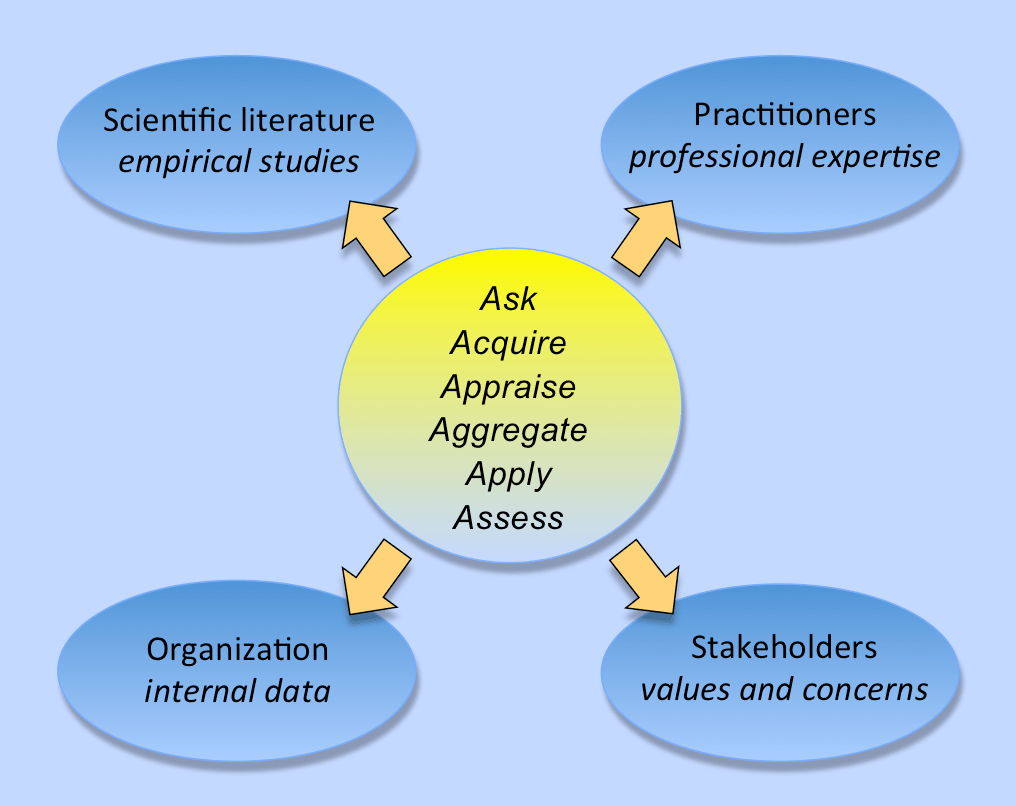
        Evidence-based management is about making decisions through the conscientious, explicit, and judicious use of the best available evidence from multiple sources:

        • Asking: Translating a practical issue or problem into an answerable question.
        • Acquiring: Systematically searching and retrieving the evidence.
        • Appraising: Critically judging the trustworthiness and relevance of the evidence.
        • Aggregating: Weighing and pulling together the evidence.
        • Applying: Incorporating the evidence in the decision-making process.
        • Assessing: Evaluating the outcome of the decision taken.

        ... to increase the likelihood of a favorable outcome.


        TBD

        References

        Share:

        The Reinventing Organizations Map

        Map to the NEXT level

        What would it mean for you to have the map that shows the path to the NEXT level where your current challenges are effortlessly resolved or become irrelevant?

        Effortless Growth

        Can you imagine how would it feel to experience effortless growth in your organization based on focusing on the right things at the right time?

        Transcend your challenges

        Would you like to know the most important areas that are holding back the growth of your organization and how to transcend them?

        References

        Share:

        The Q/E/C Method

        What is the Q/E/C Method?

        Q/E/C is one of the notetaking methods discussed by Cal Newport in his book How to Become a Straight-A Student. The name Q/E/C stands for Question/Evidence/Conclusion.

        Notes Column

        • Step 1. Write the notes in your own words.
          • Things to consider:
            • Main points, lesson objectives.
            • Bullet points / numbered processes.
            • Concise sentences.
            • Shorthand symbols.
              • Confirm (seen) or contradict (X) your thought.
              • Raise a question (?) or Confuse you (??).
              • Seems important (!) or answer a question (star)
              • Unknown words.
            • Abbreviations.
            • Paraphrase.
            • Outline.
          • Leave space between the lines to allow comments when reviewing.

        Cue Column

        • Step 2. Reduce.
          • After class use this column to reduce your notes to:
            • Keywords.
            • Phrases.
            • Concise bullets.
            • Summary statements.
            • Questions which can:
              • Clarify meaning.
              • Revel relationships.
              • Establish continuity.
              • Strengthen recall/memory.
            • Reduce your notes within 24-28 hours to improve retention.

        Summary Column

        • Step 3. Recite.
          • Cover your notes and attempt to recall keywords and phrases, and answer questions from the Cue Column.
        • Step 4. Reflect.
          • Through reflection, you will become a more active and critical thinker by targeting areas that are weak and need further exploration.
          • Use your notes to:
            • Clarify key points. 
            • Define terms.
            • Connect important concepts.

        References

        Share:

        The 3PSTM Model

        1. Plan

        • What is your PURPOSE? 
          • What is the reason you are presenting this information and what is your desired outcome? 
          • Consider what you want your audience to DO, KNOW, and FEEL following your presentation.
        • Who is your audience? 
          • What matters most to them and what questions will they have? 
          • Consider any preconceptions they might have toward you or your topic.

        2. Prepare

        • Brainstorm (independently or with others). 
        • With your audience and purpose clearly in mind, examine your topic and ask yourself the question, "What belongs in this presentation?"
        • Record your thoughts and then organize them into the 2-3 MAIN MESSAGES that will comprise your presentation.

        3. Package

        • Strong Opening (15%)
          • Establish your credibility (holistic and topic-specific)
            • "Good morning! My name is ... I’m a ... here at X and I’ve worked for Y years on the Z we’ll be discussing"
          • Explain your PURPOSE (your topic)
            • "I'm here to convince you that Z is the best ..."
          • Explain your PROCESS (your agenda)
            • "There are 3 main reasons why Z is right for you. First A is the simplest... Second, each B... Third, C comes with..."
          • Describe the PAYOFF (why the audience should listen).
            • "I'm confident I can answer all your questions, and that you’ll be very excited when you see the value, reliability, and security you can now bring to your..."
        • Body (75%)
          • Take your audience on a journey through your topic.
          • POINT 1...3. Provide strong SUPPORT for your MAIN POINTS
            • Opening. "Let’s begin by taking a look at A / The second thing B / Last look at C"
            • Support (statistics, explanations, examples, comparisons, and expert opinions or
            • Illustrate (stories, anecdotes, shocking facts, humor, and strong visuals).
            • Closing. "And that's A, the first thing you’ll be excited to share with ...!"
        • Strong Close (10%)
          • Review your MAIN POINTS.
            • "There you have it! The three main reasons Z  is the best option for you are A, B & C"
          • Restate your PURPOSE.
            • "I encourage you to... for Z, and I urge you to ..., while ..."
          • Close with POWER.
            • "Remember our motto/purpose/mission at X..."

        Share

        • Staying on Track.
          • Decide in advance when to take questions.
          • Listen attentively – let them finish.
          • Thank them, then repeat the question.
          • Answer the question, and then support your answer.
          • If you don’t know the answer, be honest.
          • Never let a question close your presentation.
        • Handling Questions.
          • Decide in advance when to take questions.
          • Listen attentively – let them finish.
          • Thank them, then repeat the question.
          • Answer the question, and then support your answer.
          • If you don’t know the answer, be honest.
          • Never let a question close your presentation.
        • Involve your Audience to Engage your Audience.
          • Open-ended questions.
          • Chat – whole group or 1:1.
          • Interactive whiteboard – flipchart suggestions or brainstorming ideas.
          • Polling – test understanding or conduct anonymous surveys.
          • Share screens.

        References

        • Connect & Deliver - Meeting and Messages by Dynamic Solutions.
        Share: