How to Self Coaching


Actionable Model

  • Step 1. Feel you're nowName your emotion (one word) and describe it.
    • "What are you feeling right now?", 
      • "I feel ___, and this is the way how I feel it in my body is: ___."
      • If happy/say, bad/good is also okay.
    • Outer awareness - Feeling the feeling.
  • Step 2. Find the sentence causing it.
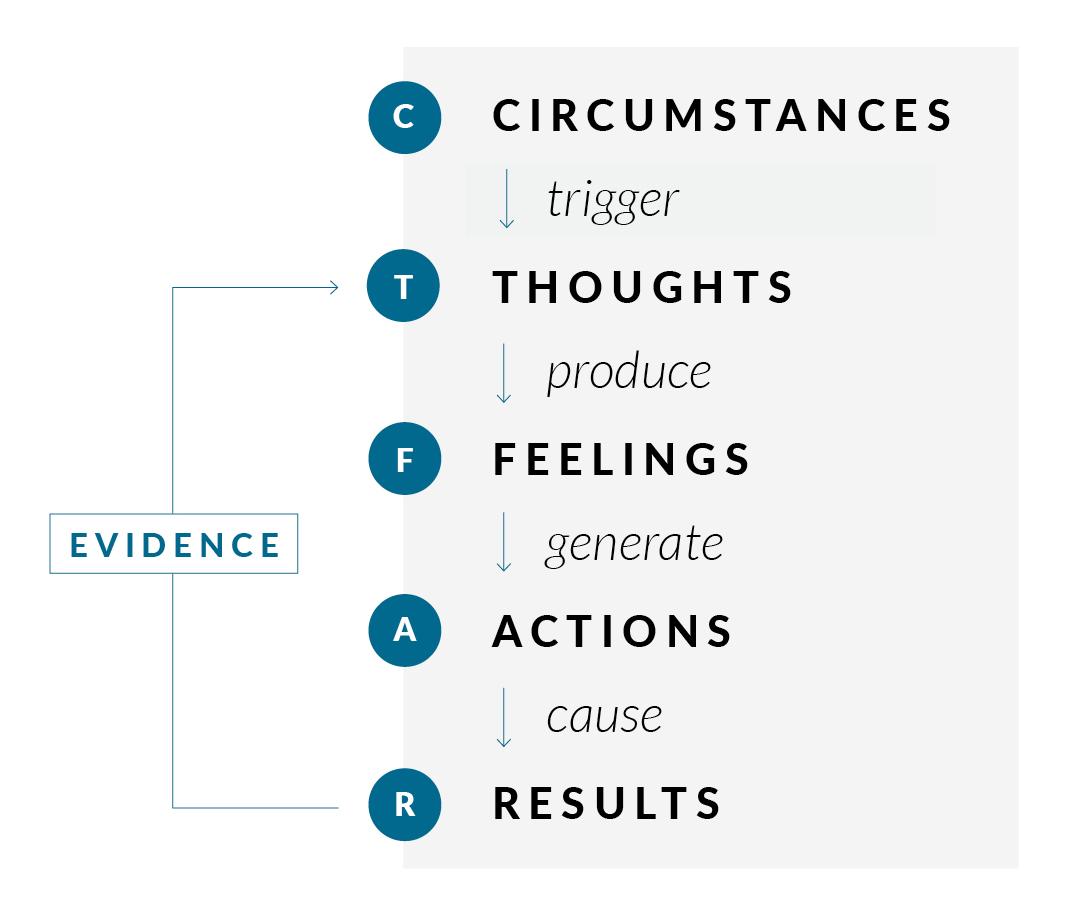
    • All feelings are caused by your thoughts. Nothing outside causes your emotions.
    • Sensations.
      • Things that happen in your body involuntarily travel to your mind.
      • Stuff outside of your case sensations. Sun makes you hot or outside makes you cold.
    • Emotions. 
      • Require consciousness that starts in your mind and travels to your body.
      • It's always caused by a sentence in your mind.
    • Not a circumstance, facts vs thoughts:
      • "I feel anxious because I lost my job" (circumstance)
        • What is your thought about "not having my job?
          • "I'm not gonna be able to pay my bills...", (thought) or
          • "I'll never be able to work again..." (thought).
    • What is my brain thinking? What sentences are being fed to me from my brain?
    • It's important to know because it's causing how you feel and if you don't know you can't change it and you are going to feel powerless, depressed, and fearful, and you do not why.
    • Every sentence in your mind is a choice.
    • You can deliberately decide what to think otherwise the brain will do it for you unsupervised.
  • Step 3. Create a new, true thought.
    • Give it equal airtime.
    • It will produce a new feeling.
    • Example"
      • "I feel inadequate" (feeling)
        • "I am not enough" (thought)
          • "because I won't be able to get all this done"
      • Then think, also consider: 
        • "I am enough " (new though)
          • "because I'm gonna get everything done I can "
        • It makes you feel worthy. 
    • You do not have to get rid of the negative if you do not want
    • You can introduce the new thought and allow yourself to feel both as well. 
    • What makes it true is that you believe it.
      • You will have to probe the new thought in certain ways and you see how that's true then you can hold that thought with the other thought.
    • Negative:
      • "I'm not going to be able to get it all done today" to
    • Positive
      • "I'm going to get half of my list today"...
      • "I'm going to get 7 things done today"...
      • ...
      • You will get some sense of accomplishment together with a sense of inadequacy.

Videos

References

  • TBD
Share:

Coaching with Clean Language

"The Five-Minute Coach offers a simple, step-by-step guide to how to coach quickly and effortlessly and get amazingly better results at work. Short, punchy, and easy to read, the user can swiftly learn this innovative and effective tool for improving performance. Designed for leaders, managers, and supervisors, in any setting, The Five-Minute Coach is a ground-breaking approach to coaching on the job" - Amazon.com

Step 1. Identify and Outcome.

  • "[And] What would you like to have happened?
    • If the answer is not an Outcome, ask:
      • "And [last answer] What would you like to have happened?"
    • If the answer is an Outcome then continue

Step 2. Choosing the best Outcome.

  • "And when [outcome in coaches words], then what happens?"
  • "And when [last answer], then what happens?"
    • Repeat the question with each answer until no new answer emerges.
  • "And [outcome] and [recap all the answers], what are you drawn to most?"
    • This is the 'new outcome'.

Step 3. Discovering more about the Outcome.

  • "And when ['new outcome'], what kind of [same word or phrase from the outcome]?"
  • "And when [last answer], is there anything else about [same word or phrase]?"
  • "And when [last answer], where is/are [same word or phrase]?"
  • "And when [last answer], whereabouts [last answer]?"
  • "And [last answer]. Given what you know, what would like to have happened?"
    • This is the 'final outcome'.

Step 4. Action Planning.

  • "And what needs to happen for ['final outcome']?"
  • "And is there anything else that needs to happen for [final outcome]?"
    • Repeat the question until you hear 'no' as an answer.
  • "And [final outcome and recap every action point]is there anything else that needs to happen for [final outcome]?"
    • Repeat the question until you hear 'no' as an answer.
  • "And [final outcome and recap every action point], and what needs to happen first? And can [previous answer]"

Step 5. Motivate to Act.

  • "And when [first thing], then what happens?"
    • Repeat until the coachee is in a positive state and seems keen to act.
  • "And is that a good place to stop?"
    • Handover notes.

References

Share:

Coaching with only 7 Questions

1. What's on Your Mind?

Use the 3P Model to focus the conversation:

  • Project. Content of the situation. Start here and see if the conversation can be moved to any of the other two Ps.
  • People. What your role is in this relationship that might currently be less than ideal.
  • Patterns. Patterns of behaviors and ways of working that you'd like to change.
  • Example:
    • After asking: "Out of curiosity, What's in your mind?"
    • Deepen the conversation: "So there are three different facets of what we could look at. Project side - any challenges about the actual content. The People side - any issue with team members/colleagues/other departments/bosses/customers/clients and Patterns - if there's a way that you're getting in your own way, and not showing up in the best possible way. Where should we start?"

2. And What Else?

  • Ask it one more time.
  • Recognize success when people say: "There is nothing else"
  • Wrapping up: 
    • "Is there anything else?"
    • "What else could you do?"
    • "What else might be possible?"

3. What's the Real Challenge here for You? 

  • The solution to the Proliferation of Challenges - too many topics at once: 
    • "If you have to pick one of there to focus on, which one here would be the real challenge for you?"
  • The solution to coaching the ghost - talking about other people, projects, or situations rather than focusing on what they can do:
    • "I think that I understand what's going on with [insert the name of other people/project/situation]. What's the real challenge here for you?"
  • The solution to abstractions & generalizations - big picture, high-level conversations/talking about "us" and "we" but not about "me" and "I":
    • "I have a sense of the overall challenge. What is the real challenge here for you?"

4. What do you want?

  • Listen if you see the need behind the person's response.
  • Universal needs:
    • Affection.
    • Creation.
    • Recreation.
    • Freedom.
    • Identity.
    • Understanding.
    • Participation.
    • Protection.
    • Subsistence.
  • Drive engagement, Increase the TERA. People are asking themself:
    • Tribe. "Are you with me or against me?"
    • Expectation. "Do I know the future or I don't?"
    • Rank: "Are you more important or less important than I am?"
    • Autonomy: "Do I get a say or don't I"

5. How can I help?

  • Soften the question:
    • "Out of curiosity, How can I help?" or 
    • "Just to know..." or 
    • "To make sure that I'm clear..."
  • You could respond: "Yes".
    • You can say Yes if it is reasonable for you.
  • How to say "No":
    • "I can't do that... but I could do...[insert counter offer]"
  • Avoid answering the question "What do you think I should do?"
    • "That's a great question, I've got some ideas, which I'll share with you. But before I do, what are your first thoughts?" Then say "that's terrific" ask 2.

6. If You are saying Yes to this, What are you saying No to?

  • Use the 3P model:
    • Projects:
      • "What projects do you need to abandon or postpone?"
      • "What meeting would you no longer attend?"
      • "What resources do you need to divert to the Yes?"
    • People:
      • "What expectations do you need to manage?"
      • "From what drama triangle will you extract yourself?"
      • "What relationship will you let wither?"
    • Patterns:
      • "What habits do you need to break?"
      • "What old stories or dated ambitions do you need to update?"
      • "What beliefs about yourself do you need to let go of?"
  • How to say No when you can't say No
    • Part 1. Slowly or partially:
      • "Why are you asking me?"
      • "Whom else have you asked?"
      • "When you say this is urgent, what do you mean?"
      • "If I couldn't do all that of this, but could do just a part, what part would you have me do?"
      • "What do you want me to take off my plate so I can do this?"
    • Part 2. Directly to the request not to the person.
      • "I'm afraid I have to say No to this"
  • Other 5 strategic questions:
    • "What is our winning aspiration?"
    • "Where will we play?" - choose a sector
    • "How will we win?"
    • "What capabilities must be in place?"
    • "What management systems are required?"

7. What was most useful for you?

  • Extracts what was useful

Deepen Coaching 

  • Sequence: 1-2a-3, 2a-2b-3

Covered Scenarios

  • How to say no.
  • The 3P model.
  • Feelings and Needs.

References

Share:

How to Hold Someone Accountable

"Behind the problems that routinely plague our organizations and families, you'll find individuals who are either unwilling or unable to deal with broken promises. Colleagues break a rule, coworkers miss a deadline, friends fail to live up to commitments (or just plain behave badly), and nobody says a word. Nobody holds anyone accountable. With repeated infractions, individuals become increasingly upset until they finally do speak their minds, but they do so poorly--often creating whole new sets of problems." - Amazon.com

Actionable Model

Share:

How to Get Prepared for a Crucial Conversation

"Crucial Conversations provides powerful skills to ensure every conversation―especially difficult ones―leads to the results you want. It teaches how to be persuasive rather than abrasive, how to get back to productive dialogue when others blow up or clam up, and it offers powerful skills for mastering high-stakes conversations, regardless of the topic or person." - Amazon.com

Actionable Model

Before you Speak

1. Get Unstuck

What problem should you address? (CPR)

  • Identify where you are stuck.
    • What bad results do you want to fix?
    • What good results are you currently unable to achieve?
    • What problems are you always trying to fix?
    • What would people complain about at home and work?
  • Unbundled with CPR.
    • Content. A single instance of a problem (the action itself of immediate consequences)
    • Pattern. Recurring problem (pattern overtime)
    • Relationship. How the problem is affecting your relationship (trust, competence, respect)

2. Start with Heart

  • Learning to focus on what you really want.
    • What I am behaving like I want?
    • What results do I really want -
      • for myself?
      • for others?
      • for the relationship?
      • for the organization?
    • How would I behave if I really did?

3. Master My Stories

What do you really want for yourself, the other, your relationship, and the organization?
  • Skill 1. Separate facts from Stories.
    • Fact is something that can be proven through observation or measurement.
    • Stories are judgments, conclusions, and attributions.
  • Skill 2. Watch for Three Clever Stories.
    • Victim Stories: "It's not my fault..."
    • Villian Stories: "It's all your fault..."
    • Helpless Stories: "There is nothing else I can do..."
  • Skill 3. Tell the rest of the Story.
    • What am I pretending not to notice about my role in the problem?
    • Why would a reasonable, rational, and decent person do this?
    • What would I do right now to move towards what I really want? 

During the Conversation

1. STATE My Path

  • Share your facts. 
    • Start with what see and hear. Include how that differs from your expectations.
      • "I noticed that..."
      • "Twice you..."
      • "Last three times we talked about this..."
      • "I was expecting to receive this by X and it's now Y..."
  • Tell your story. 
    • How the story you are sharing differs from a clever story?. 
      • "I'm beginning to wonder if..."
      • "It seems to me..."
      • "It leads me to conclude that..."
      • "I believe that..."
      • "I start to think that..."
  • Ask for others' paths. 
    • Be humble, let others share new ideas, and challenge your story.
    • Effective:
      • "How do you see it?"
      • "Can you help me better understand?"
      • "What is your view?"
    • Ineffective:
      • "Isn't that the case?"
      • "What can we do to make sure this doesn't happen again?"
      • "No one disagrees with that, do they?"
  • Talk tentatively.
    • Tell your story as a story, not as a fact.
    • Allow room for others' stories.
    • Avoid absolutes.
    • Too Forceful vs Tentative:
      • "The fact of the matter is...." - "In my opinion..."
      • "That's a dumb idea..." - "Maybe this would make more sense..."
      • "The only reasonable option is to..." - "I believe that we should do is..."
      • "If I agree with you, then we'd both be wrong..." - "I'm wondering if that example applies to our company"
  • Encourage testing.
    • Add more meaning to the pool.
      • "What happened...?"
      • "Can you help me to understand...?"
      • "What am I missing...?"
      • "Do you see it differently?"

2. Learn to Look

Watch to see if the Respondent shows signs that they are feeling unsafe or signs of defensiveness because they have misinterpreted your intent. Watch for signs of Silence or Violence.
  • Learn to Look For When a Conversation Becomes Crucial
    • High Stakes.
    • High Emotions.
    • Oppositive Opinions.
  • Learn to Look For Signs of Silence of Violence in Yourself and others
    • Silence: Action taken to withhold information.
      • Avoiding.
      • Masking
      • Withdrawing
    • Violence: Action is taken to compel others towards your point of view
      • Attacking.
      • Controlling.
      • Labeling.

3. Make it Safe

Step out of the content. Stop talking about the issue and address the safety concerns. Rebuild safety: Mutual Purpose, Mutual Respect. Then step back in.
  • Apologize when appropriate.
  • Use contrast to address misunderstandings.
  • In the "don't" half of your statement, answer:
    • How might others mistake my purpose?
    • How might they feel disrespected?
  • In the "do" half of your statement, answer:
    • What is my real motivation?
    • How do I really feel about that person?
  • When to use contrasting:
    • In the moment. When you notice others become defensive.
    • Upfront. If you believe there is a high likelihood that the other person will misunderstand your intent.
      • "I don't think/mean/want... (their fear/misunderstanding)"
      • "I do think/mean/want... (your actual purpose or meaning)"
  • Take Four Steps to Create Mutual Purpose (Violence).
    • Commit to seeking mutual purpose. Breaking an impasse to seek the interest of others.
      • "Can we look for something we both agree on?..."
      • "It appears we're at an impasse. I'd like to see if we can come up with some shared goals..."
      • "This doesn't seem to be working. Let's see if we can come up with some common objectives..."
      • "It seems we are stuck here. Why don't we spend some time looking for something that will satisfy both of us?"
  • Recognize the purpose behind the strategy. Find the purpose by asking why they want what they want and getting both of your meanings into the pool.
    • "Let me understand where you are coming from"
    • "What are you trying to achieve?"
    • "What is it you want..."
  • Invent a Mutual Purpose. Look for a higher level, longer-term purpose.
    • "So, if we can get the project finished on time AND within the existing budget we will be both satisfied, right?"
    • "I want to spend our discretionary fund to redo our branding. You are interested in funding additional R&D. What we both want is to have the best long-term impact on our division's financial goals. I'm fine putting off regarding if it's the best long term interest of our division"
  • Brainstorm New Strategies.
    • With a clear mutual purpose, you can join forces in searching for a solution that serves everyone.

4. Explore Others' Paths 

Help others leave silence or violence and join you in dialogue.
  • Added AMPPs.
    • Ask them to get things rolling. 
      • Invite them to share their thoughts and feelings.
      • Show genuine interest.
      • "I want to know what you think about..."
      • "What did you hear/see to let you to that conclusion?..."
    • Mirror to confirm feelings.
      • "You are saying X, but your tone of voice and posture say Y"
    • Paraphrase to Acknowledge the story.
      • "Let's see if I've got this right. You came something around... but..."
    • Prime when you are getting nowhere.
      • "Is it something that I've done that has you upset"
      • "It's ok to share what you are really thinking and feeling. I won't be offended..."

After

1. Move to Action

  • Who does what by when and follow up

Resources

Share:

The Enterprise Scrum Framework

What is Enterprise Scrum?

Enterprise Scrum is an adaptation and extension of Scrum based on abstraction, generalization, and parameterization; that can be used in a scaled generic way for any management purpose.

The goal of the Enterprise Scrum is to grow unicorns and transform dinosaurs into unicorns. In other words, Enterprise Scrum powers DISRUPTION and allows companies of all sizes to be managed like startups which can simultaneously act like VCs as they grow up. 

Many of the Roles and Artifacts in Enterprise Scrum are named differently to not confuse other business people with the word "product".

Roles

  • Business Owner. Used instead of the Product Owner (PO) role.
  • Coach. Used instead of the Scrum Master (SM) role.
  • Team. It is still the Team.

Business Value

  • It is defined explicitly through a balance of the metrics (see below).

Artifacts

  • Value List. Used instead of "Product Backlog".
    • A list of things that when DONE add value. 
  • Value List Items (VLIs). Instead of Product Backlog Items (PBIs).
    • Each of them with a DOR, DOD, and other attributes. 
    • VLIs are DONE according to their DOD every Cycle. 
  • Projections
    • These are made with measurements over metrics of what got DONE (see below), so Release Planning is naturally included for all Cycles and at all levels.

Events

  • Cycle. Used instead of Sprints.
    • Cycles can be recursive without limit. 
    • You can have a yearly cycle, a quarterly cycle, or a 2-week cycle.

Techniques

  • Techniques of different types and at different levels can be included with specific parameters and inserted as 1) new steps, 2) to get work done into the framework relevant to the purpose of the instance (see below).
  • For example, techniques can be added for 1) facilitating work like User Stories, or 2) insertable NEW steps in an instance like Release Planning, or Architectural Scan added as NEW activities in the Initial Value List/Wave Projection.

Metrics and Reports

  • The only mandated report is the ScrumBoard.
  • In contrast with Scrum with 1 metric, the velocity, in Enterprise Scrum we are FREE to have as many metrics as you want/need. For example, we could track, profit, revenue, incidents, effort, customer satisfaction, compliance levels, etc.
  • In contrast with Scrum where we have the Burn down charts, in Enterprise Scrum you are FREE to choose any type of report.

Other Parameters

  • Enterprise Scrum also provides 80+ other parameters to extend, customize and apply the Scrum concepts to different domains, scaling, or adding techniques. 
  • These parameters were abstracted primarily by observing what people had already done in the field as they used Scrum for different purposes. 
  • These parameters make Enterprise Scrum a true framework, as the customizable parts are now visible and explicit. (I will release the full list of parameters later as a different publication.)

Instances

  • The framework exists as an explicitly customizable tool, but once the parameters, techniques, and added steps have been chosen, a defined Enterprise Scrum instance is created explicitly. For example, there are instances like:
    • the instance of Enterprise Scrum with User Stories and Release Planning.
    • the instance of Enterprise Scrum for Marketing.
    • the instance of Enterprise Scrum for Compliance Management.
    • the instance of Enterprise Scrum for Real State Sales.
    • the instance of Enterprise Scrum for Business Unit Portfolio management.

The Wave Principle

  • Any long-term "rough" predictions made in the Initial Value List of a longer Cycle, must be refined or recalculated after each and every shorter Cycle it includes.

References

Share:

The Fluid Teams

What are Fluid Scrum Teams?

Fluid Scrum Teams organize themselves based on the work at hand. It is a vital aspect of approaches like Open Space Technology and FAST Agile. 

  • Every time new topics need to be addressed, the people of the Fluid Scrum Teams organize themselves to optimize the chances of success of the challenges. 
  • They form smaller teams each Sprint to maximize their effectiveness.

Suppose your pool of people is 20, these people organize themselves into 2 to 7 teams to address specific topics.

Fluid Scrum Teams and Scrum events

  • Sprint Planning:
    • All the Developers that work on the product, the entire pool of people, are present. 
    • The Product Owner proposes a number of objectives for the upcoming Sprint. 
  • Sprint Objectives:
    • A discussion to agree upon the objectives.
    • People of the Fluid Scrum Team self-organize themselves around the objectives.
    • They decide how to split into multiple teams working on their own objectives during one Sprint.
  • Daily Scrum:
    • The teams have their own Daily Scrums.
  • Sprint Review.
    • There's one Sprint Review reflecting upon the outcome of the work of all the teams. 
    • In every Sprint, different teams will be formed to address the objectives.
  • Fluid Scrum Teams are cross-functional.
  • Fluid Scrum Teams and self-management

Team Types

  • Complete fluidity.
    • In every Sprint, the teams that are formed can be totally different, depending on the problems at hand. 
    • This is a solution for environments that are especially complex and every new problem is distinctly different from previous problems.
  • Partial fluidity.
    • A part of the pool of people is working in stable steams addressing topics of a certain nature for multiple Sprints. 
    • Another part is fluid and organizes again and again. 
    • This approach is helpful for environments with elements of high complexity and also elements of lower complexity.
  • Specific fluidity.
    • A smaller group of people with special skills are assigning themselves to teams based on the need for their skills. 
    • Many organizations work like this. Especially when they have people that can’t work with a single team full-time. 
    • Think architects, database administrators, network specialists, and salespeople.
  • Fully stable teams.
    • The teams will not change for a longer period. 
    • In every Sprint, the teams have the same composition. 
    • This can be a good approach for environments that are complex, but with a high degree of predictability of the type of work at hand.

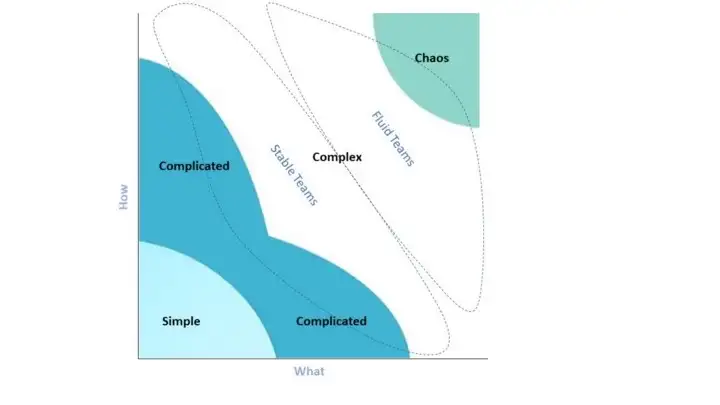
In complex environments, Fluid Scrum Teams can increase agility. By relaxing the constraint on stable teams, your teams will be able to handle increased complexity and tame the chaos.

References

Share:

The FAST Framework

FAST is the acronym for Fluid Scaling Technology. Fluid Scaling Technology combines OpenSpace Technology1 and Open Allocation to create a  lightweight, simple-to-understand, and simple-to-master method for organizing people around work - that scales.

Where and When to use FAST

  • FAST is ideally suited for business environments or challenges that show complexity, rapid change, or where there is a need for innovation. 
  • FAST is ideal for software development, product development, and agile at scale - because of their typically complex nature. 
  • FAST is applicable to most complex collaborative endeavors and is not limited to just the software domain.
  • FAST is built on fluid (re)teaming rather than static teams to maximize adaptability.
  • FAST is the same process at the small through to the large scale.
  • FAST is not built on Scrum. Instead, FAST is built on OpenSpace Technology.
  • FAST operates as a pure complex system
    • FAST also accommodates complicated and simple work.

FAST Roles

  • Product Manager
    • This role is not one of authority and command but more inspiration. 
    • Motivation, encouragement, communicating a clear vision, recommunicating the vision often, direction setting, standard-setting, providing feedback, and modern product management.
  • Team Members
    • A T-shaped team player committed to delivery, collaboration, communication, listening, continuous learning, and personal mastery.
    • Generalizing specialists.
  • Team Steward:
    • Natural leadership role where a Team Member has chosen to steward some work in a Value Cycle
    • Just as teams are fluid in FAST, team stewardship is fluid and not static.
  • Feature Steward (Optional):
    • As teams are not static in FAST, it can make sense for at least one person to stay with a feature/opportunity/outcome to see it all the way through to completion. 
    • Provide continuity across Value Cycles and serve as a point of contact for stakeholders. 
    • It is not required to work continuously on the feature they are stewarding, only to have a continuous understanding of the work.

FAST Artifacts

  • Product Map – The Big Picture.
    • It's an extension of Jeff Patton's Story Mapping (Patton). The difference is that a Product Map focuses on high-level elements only, e.g. bets, capabilities, opportunities, aspects, desired outcomes, business goals, initiatives, themes, and features.
    • It's s a way to visualize what the Collective is doing as a whole. The map shows progress at a high level by the ratio of started, not started, and done.
    • Finer-grained details of high-level items are represented in Discovery Trees.
  • Discovery Trees – Thinking Big While Working Small.
    • Whenever work starts on a high-level item, create a Discovery Tree. A Discovery Tree represents the complexity of work while giving context to work items.
    • Break down work to understand, discover, or plan. But only just enough and just in time. 
    • As work recursively gets broken down from a high-level item into smaller subcomponents, a structure of branch and leaf nodes reveals itself.
    • The current progress toward node completion is evident by the ratio of nodes started, not started, or completed (or removing completed nodes from the tree).
  • Marketplace Board.
    • It visually represents a marketplace of work for a Value Cycle. 
    • The board shows what is happening in the current Value Cycle and who is on which team. (The FAST Marketplace Board borrows from OpenSpace's Bulletin Board.)
    • Each column on the Marketplace Board might represent a physical collaboration area. 
    • To constrain work in progress (WIP), limit the number of places available in the Marketplace.
    • On the board, this might mean restricting or removing columns.
  • Collective Agreements – How We Self-manage
    • It's a living document that describes the rules and mechanics of self-management within the Collective. Collective Agreements create and protect harmony and psychological safety. At a minimum, it should include: 
      • How do we make decisions?
      • How do we resolve conflict?
      • How do we change the Collective's Agreements?
      • Where do we keep the Agreements?

FAST Meeting

The FAST Meeting is the only event in FAST and it is facilitated by the FAST Product Manager. The current Value Cycle is declared closed, and the next starts.

  • Phase 1: Closing the Current Value Cycle.
    • Collective Synchronisation via Show and Tell. A representative from each team briefly summarises their team's work in the last Value Cycle, highlighting value delivered and discoveries made. It includes concise demonstrations if helpful.
    • Once all teams have completed their show and tell, the Value Cycle is closed.
    • Clear the Marketplace Board in readiness to repopulate again in the next Value Cycle.
  • Phase 2: Starting the Next Value Cycle
    • Reiterate Vision and Set Direction
    • Each FAST Meeting is an opportunity for the Product Manager to align, rally, and reinspire the Collective by reiterating the product vision, mission(s), and purpose. In addition, the Product Manager may choose to set priorities or direction for the Value Cycle. 
    • The Product Map can be a useful visual aid for this, and why having it on permanent display in the forum is recommended. 
  • Phase 3: Emerging Work & Self-selecting into Teams.
    • Create and Open the Marketplace.
    • Any Member can stand up in front of the Collective and declare their intent to steward a goal. The goal may be related to priorities just announced. Or not.
    • Once volunteers have stopped coming forward to steward work or the WIP limit has been reached, the Marketplace is declared open.
    • Collective Members then self-select into whichever team they feel they can contribute the most value to, or learn and grow the most from. 
    • Members go to the Marketplace Board and put their names into the slot associated with the goal they are interested in working on for that cycle.
    • Teams might be a component, feature, discovery team, or other, dependent on the work.
    • Teams have the autonomy to do whatever they feel is the best and right thing needed to add value.
  • Announcements (Optional)
    • The Collective being gathered is an opportunity to make announcements. Announcements may be unrelated to work in the Value Cycle but are still relevant to the Collective.
  • Starting Work - Resolve Dependencies, Architect, Design, Plan, and Collaborate.
    • The dynamically formed teams now go to their chosen development area and plan. Each team tasks out their work and agrees on how they will collaborate. Should a team identify that they are likely to clash with another team or have dependencies, they meet with the other team(s) and discuss. To resolve dependencies or clashes, they might:
      • Merge.
      • Pick up some other work.
      • Have a design discussion, then plan if and how to divide labor.
      • Resolving dependencies this way can happen at any point in the cycle.

FAST Cadence and Flow

  • Synchronize the Collective to a shared understanding (via show and tell).
  • The pause between cycles is a sensing point to adjust teams, or work items should a better fit make sense. What was discovered in the last cycle? Has our understanding of the work or customer changed? Did any metrics change? Etc.
  • Revisit the purpose and vision of the product and company. Repetition, repetition... 
  • Cycles are not time boxes. Sign-off can happen at any point. Therefore, continuous delivery/deployment is a compatible natural fit and highly recommended for FAST.

FAST Adoption

FAST is a method that works on a small scale, large scale, and everything in between. It is the same process throughout, with only a few minor differences. A Collective is typically responsible for only one product or value stream in its entirety, but multiple products for a Collective are feasible. In the case of multiple products, the Product Manager can be singular or plural.
  • Small-scale FAST – Fewer Than 14 People. 
    • Use small-scale FAST when a Team has (roughly) fewer than fourteen people. 
    • Small-scale FAST can replace/supersede Scrum.
    • The collaboration units that Collective breaks into are smaller than in large-scale FAST. 
    • The smallest collaboration unit in small-scale FAST is two people, and pair programming is recommended when two. 
    • Mob Programming (Pearl) works well for collaboration units larger than two people.
  • Large-scale FAST – 14 to 200 People. 
    • Large-scale FAST is for a Collective of around fourteen or more people.
    • Collaboration units are typical agile software team sizes, e.g. 3-13 people.
    • Once a Collective grows too far past Dunbar's number (150), split and spin off a new Collective.
  • FAST Portfolio describes multiple Collectives. 
    • Working in this mode, FAST Product Managers meet for portfolio discussions.

FAST in Enterprise

  • FAST can integrate with other enterprise methods such as BOSSA nova, FLEX, and SAFe.

FAST Continuous Improvement.

  • FAST is not prescriptive on methods for implementing the principle of reflect and tune.
  • Each Collective should experiment and discover what works best. Some ideas and options:
    • Form a FAST Guild that meets on cadence to reflect and tune.
    • Host regular OpenSpace Events for the Collective with the theme Reflect and Tune.
    • Add a Turn Up the Good section to the FAST Meeting.

References

Share:

The Scrum@Scale Framework

Scrum of Scrums (SoS)

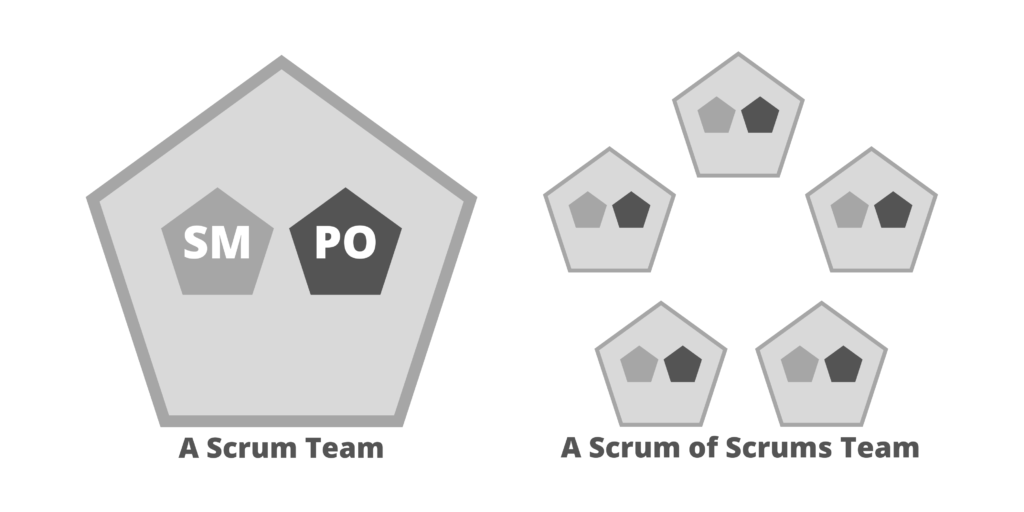
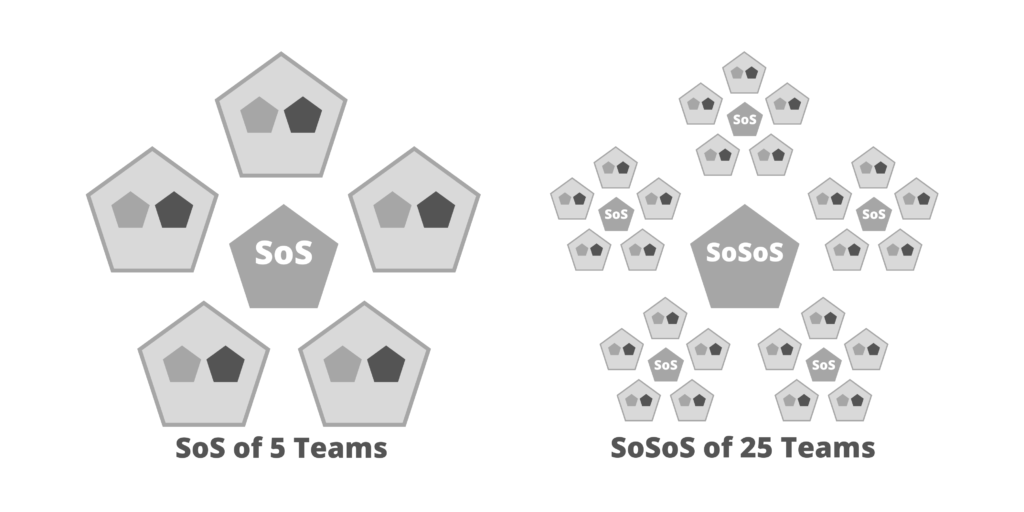
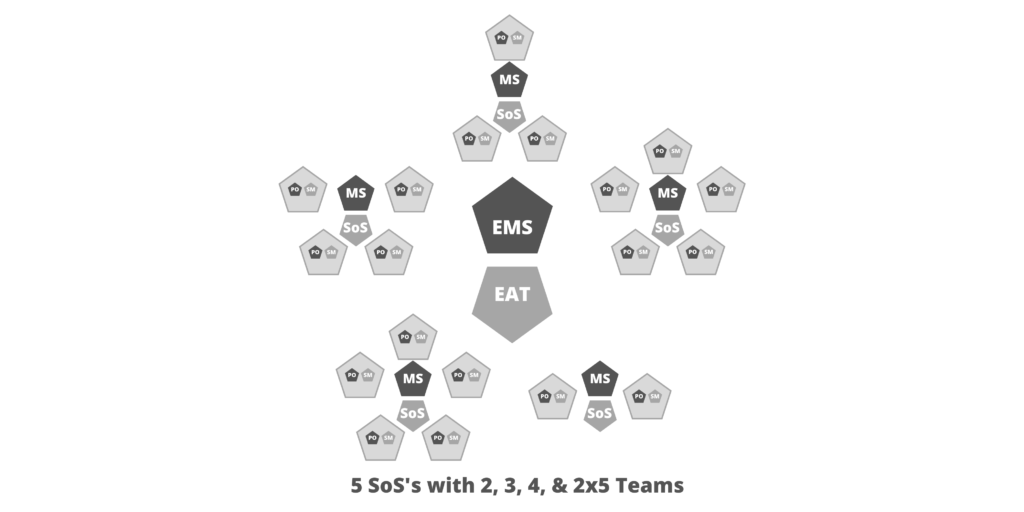
A Scrum of Scrums operates as if it were a Scrum Team, satisfying the Team Process component with scaled versions of the Scrum accountabilities, events, and artifacts. While the Scrum Guide defines the optimal team size as being fewer than 10 people, Harvard research has determined that the optimal team size is 4.6 people (on average). Therefore, the optimal number of teams in a Scrum of Scrums is 4 or 5.

As a dynamic group, the teams composing the Scrum of Scrums are responsible for a fully integrated set of potentially shippable increments of product at the end of every Sprint. Optimally, they carry out all of the functions required to release value directly to customers.

Scrum of Scrums of Scrums (SoSoS)

Depending upon the size of the implementation, more than one Scrum of Scrums may be needed to deliver a complex product. In such cases, a Scrum of Scrum of Scrums (SoSoS) can be created out of multiple Scrums of Scrums. Each of these will have scaled versions of each Scrum of Scrums’ roles, artifacts, and events.

Scaled Events

  • Scaled Daily Scrum (SDS)
    • The main talking points of a Daily Scrum are the progress towards the Sprint Goal and impediments to meeting that commitment. 
    • In a scaled setting, the Scrum of Scrums needs to understand collective progress and be responsive to impediments raised by participating teams; therefore, at least one representative from each team attends a Scaled Daily Scrum (SDS)
    • Any person or number of people from participating teams may attend as needed.
    • To optimize collaboration and performance, the Scaled Daily Scrum event mirrors the Daily Scrum, in that it:
      • Is time-boxed to 15 minutes or less.
      • Must be attended by a representative of each team.
      • Is a forum to discuss how teams can work together more effectively, what has been done, what will be done, what is going wrong & why, and what the group is going to do about it
      • Some examples of questions to be answered:
        • What impediments does a team have that will prevent them from accomplishing their Sprint Goal or that will impact the delivery plan?
        • Is a team doing anything that will prevent another team from accomplishing their Sprint Goal or that will impact their delivery plan?
        • Have any new dependencies between the teams or a way to resolve an existing dependency been discovered?
  • Scaled Retrospective
    • Every Sprint, the Scrum of Scrums holds a scaled version of the Sprint Retrospective where the Scrum Masters of each team get together and discuss what experiments have been done to drive continuous improvement and their results. 
    • Additionally, they should discuss the next round of experiments and how successful improvements can be leveraged across the group of teams or beyond.

Scaled Accountabilities

  • Scrum of Scrums Master (SoSM)
    • The Scrum of Scrums Master is accountable for ensuring the Scaled events take place, are productive, positive, and kept within the time box. 
    • The Scrum of Scrums Master may be one of the team's Scrum Masters or a person specifically dedicated to this role. 
    • They are accountable for the release of the joint teams' efforts and continuously improving the effectiveness of the Scrum of Scrums. This includes greater team throughput, lower cost, and higher quality. In order to achieve these goals, they must:
      • Work closely with the Chief Product Owner to deliver a potentially releasable product increment at least every Sprint.
      • Coordinate the teams’ delivery with the Product Owners' Team's release plans
      • Make impediments, process improvements, and progress visible to the organization
      • Facilitate the prioritization and removal of impediments, paying particular attention to cross-team dependencies
  • Executive Action Team (EAT)
    • It fulfills the Scrum Master accountabilities for an entire agile organization. This leadership team creates an agile ecosystem that allows the Reference Model to function optimally, by:
      • Implementing the Scrum values
      • Assuring that Scrum roles are created and supported
      • Scrum events are held and attended
      • Scrum Artifacts and their associated commitments are generated, made transparent, and updated throughout each Sprint.
      • Formulating guidelines and procedures that act as a translation layer between the Reference model and any part of the organization that is not agile.
    • The Executive Action Team is accountable for removing impediments that cannot be removed by members of the Scrum of Scrums (or wider network).


Notes

  • Scrum@Scale is also known as Scrum of Scrums.

References

Share:

The LeSS Framework

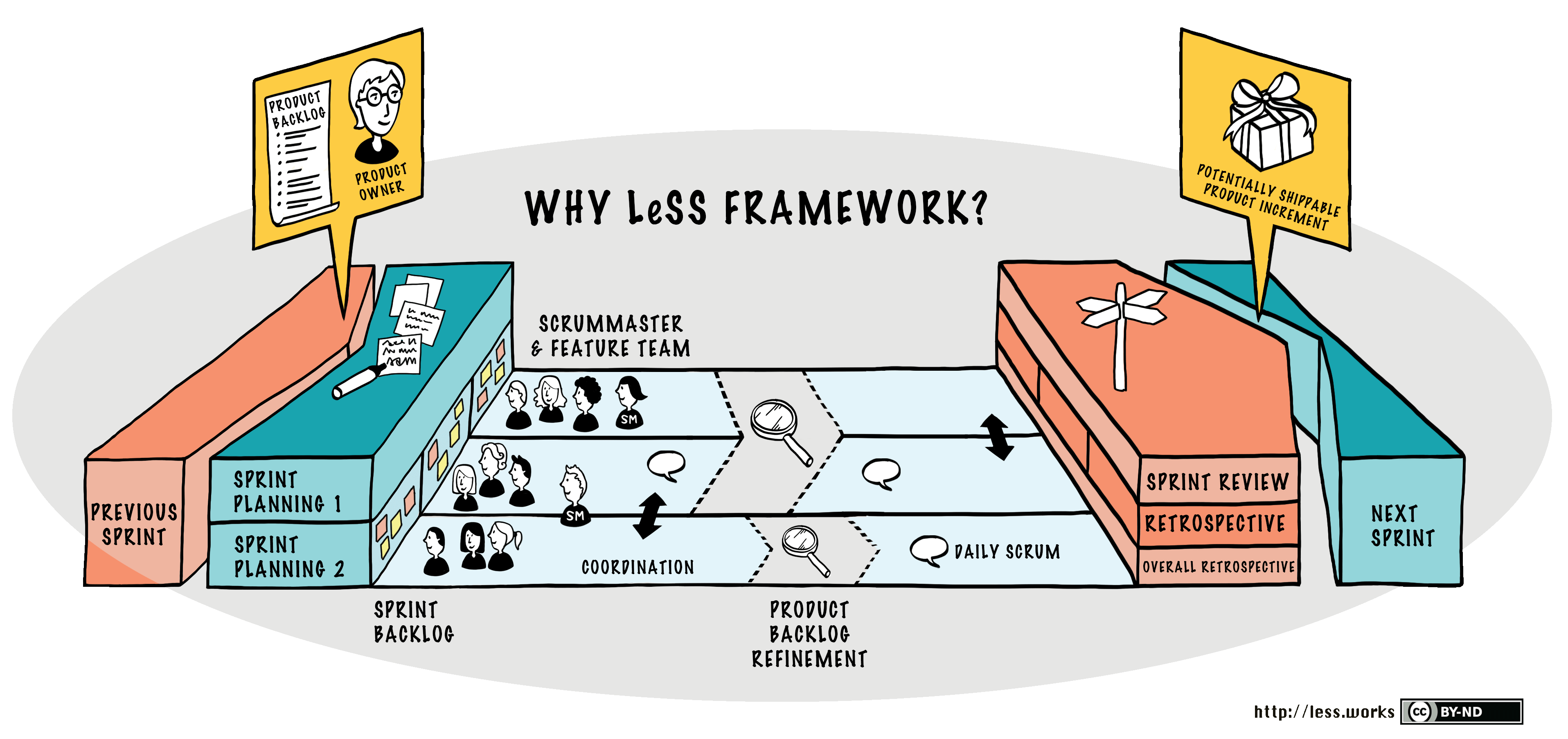
Agile development with Scrum requires a deep organizational change to become agile. Therefore, neither Scrum nor LeSS should be considered merely a practice. Rather, they form an organizational design framework.

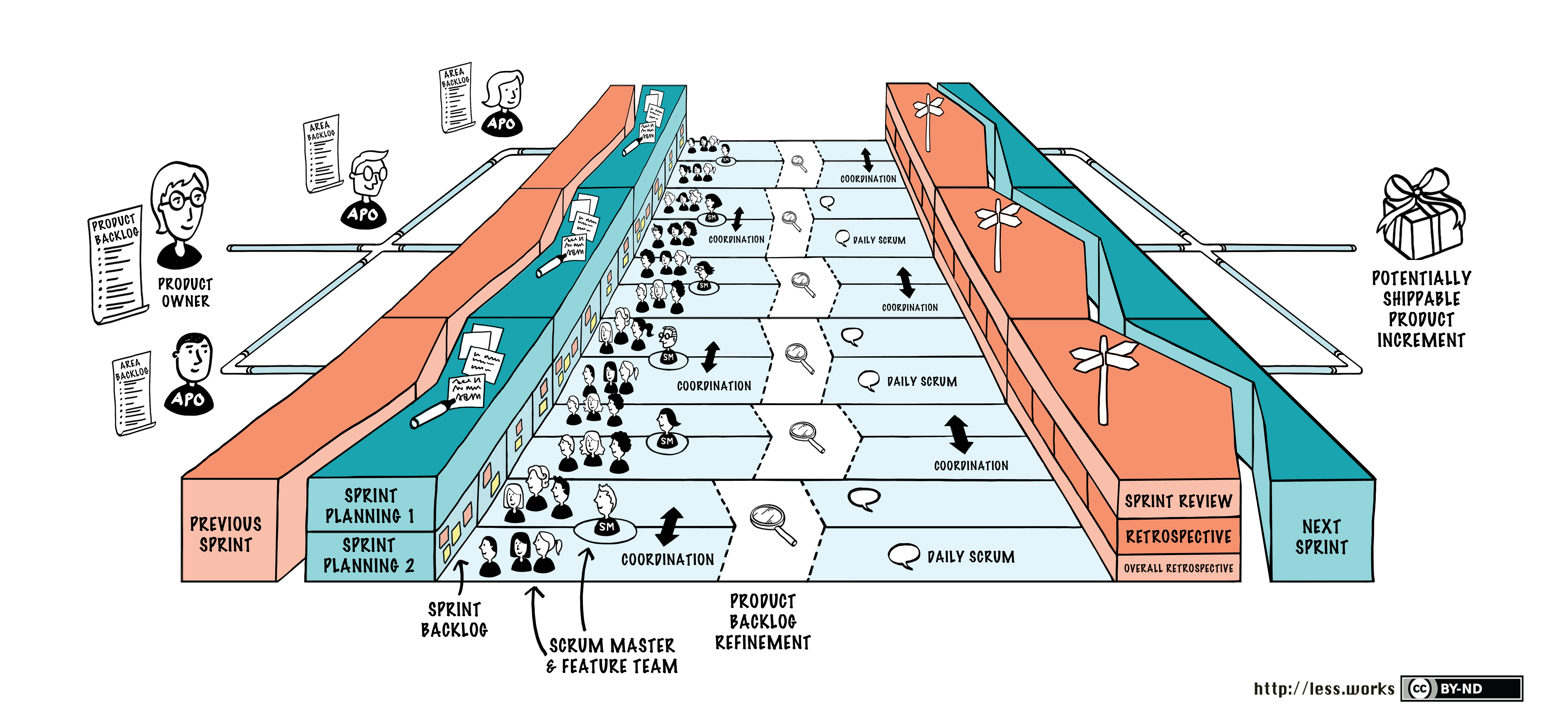
LeSS provides two different large-scale Scrum frameworks. Most of the scaling elements of LeSS are focused on directing the attention of all of the teams to the whole product instead of "my part." Global and "end-to-end" focus are perhaps the dominant problems to solve in scaling. The two frameworks – which are basically single-team Scrum scaled up – are:

  • LeSS: Up to eight teams (of eight people each).
  • LeSS Huge: Up to a few thousand people on one product.

Same as Scrum

LeSS is a scaled-up version of one-team Scrum, and it maintains many of the practices and ideas of one-team Scrum. In LeSS, you will find:
  • A Single Product Backlog (because it’s for a product, not a team),
  • One Definition of Done for all teams.
  • One Potentially Shippable Product Increment at the end of each Sprint.
  • One Product Owner.
  • Many complete, cross-functional teams (with no single-specialist teams),
  • One Sprint.

Different than Scrum

  • Sprint Planning Part 1: In addition to the one Product Owner, it includes people from all teams. Let team members self-manage to decide their division of Product Backlog Items. Team members also discuss opportunities to find shared work and cooperate, especially for related items.
  • Sprint Planning Part 2: This is held independently (and usually in parallel) by each Team, though sometimes for simple coordination and learning two or more Teams may hold it in the same room (in different areas).
  • Daily Scrum: This is also held independently by each Team, though a member of Team A may observe Team B’s Daily Scrum, to increase information sharing.
  • Coordination: Just Talk, Communicate in Code, Travelers, Open Space, and Communities.
  • Overall PBR: There may be an optional and short overall Product Backlog Refinement (PBR) meeting that includes the Product Owner and people from all teams. The key purpose is to decide which teams are likely to implement which items and therefore select those items for later in-depth single-team PBR. It is also a chance to increase alignment with the Product Owner and all teams.
  • Product Backlog Refinement: The only requirement in LeSS is single-team PBR, the same as in one-team Scrum. But a common and useful variation is multi-team PBR, where two or more Teams are in the same room together, to increase learning and coordination.
  • Sprint Review: In addition to the one Product Owner, it includes people from all teams, and relevant customers/users, and other stakeholders. For the phase of inspecting the product increment and new items, consider a “bazaar” or “science fair” style: a large room with multiple areas, each staffed by team members, where the items developed by teams are shown and discussed.
  • Overall Retrospective: This is a new meeting not found in one-team Scrum, and its purpose is to explore improving the overall system, rather than focusing on one Team. The maximum duration is 45 minutes per week of Sprint. It includes the Product Owner, Scrum Masters, and rotating representatives from each Team.

Less Huge

References

Share: